Skip to main contentNIA Resource Hub | Be Like Wat3r Exposure LLC | Michigan Foo
BLWE football athlete development image

BLWE

BLWE

Virtual Recruiting · Position · Sport Development Coaching

A Be Like Wat3r Exposure Resource

NIL Resource Hub

An original athlete-resource system for approved profiles, transparent rankings, recruiting information, educational resources, opportunities, organizations, events, and editorial content.

Private contact, guardian, evidence, and internal evaluation data are not public.

Education First

NIL and college recruiting require informed decisions.

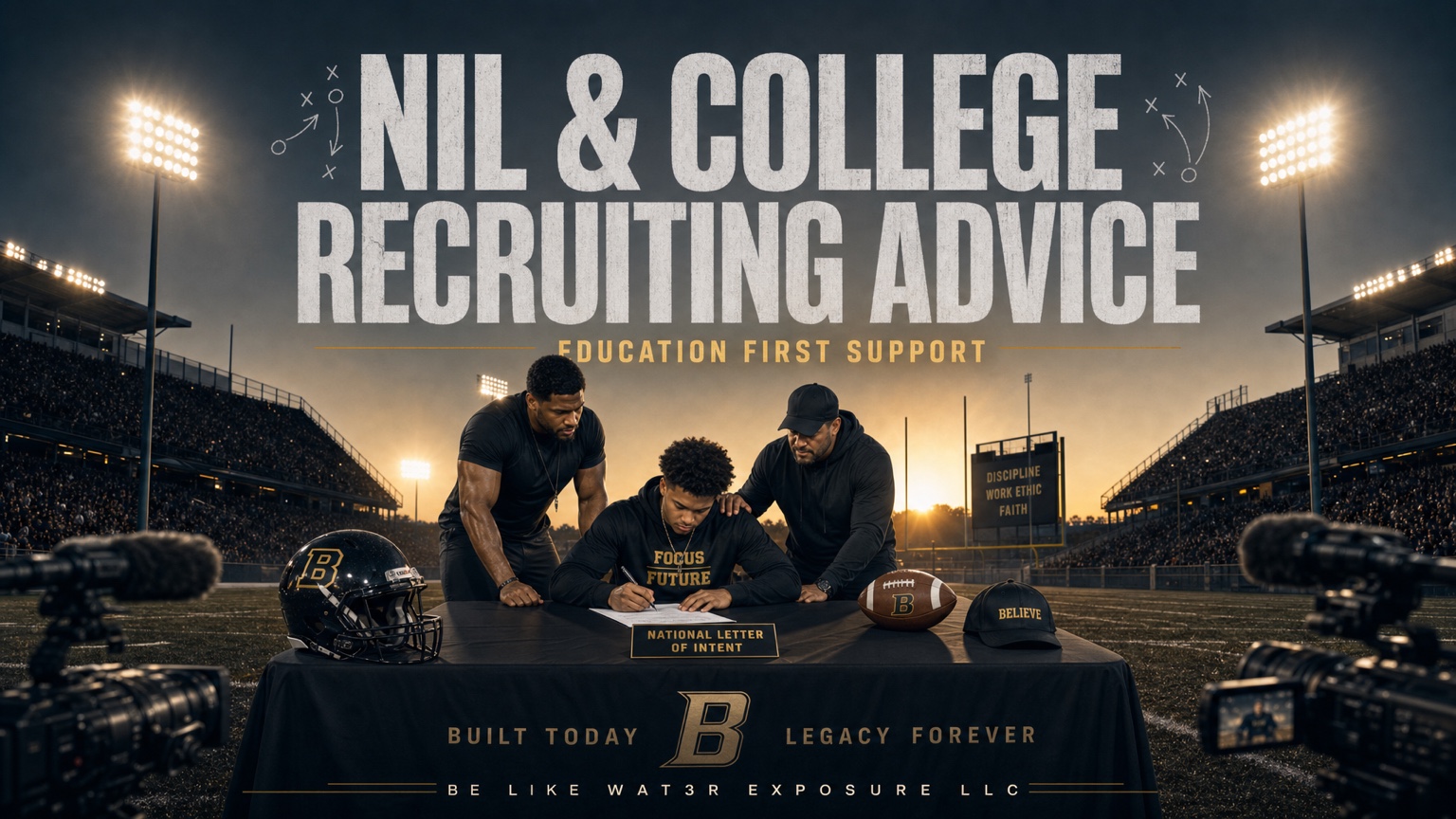
BLWE NIL and college recruiting advice graphic

NIL + Recruiting

Education First Support

BLWE organizes educational resources around recruiting, NIL awareness, athlete decision-making, and next-step planning without promising deals, offers, scholarships, or roster outcomes.

Recruiting Resources
NIL Education

NIL Starts With Readiness

Know the rules first. Build the athlete, academics, communication, and decision-making foundation before treating NIL as a shortcut.

Build Athlete Readiness

NIL and Athlete Brand Film

Build the Athlete Brand Carefully

An education-first BLWE film supporting responsible athlete brand development.

Build the Athlete Brand Carefully

A cinematic BLWE feature supporting education-first athlete brand development.

Added BLWE Resource

NIL Resource Hub

Explore NIL education and athlete resources within Be Like Wat3r Exposure. BLWE camps, combines, training, evaluations, mentorship, recruiting resources, and exposure services remain intact.

Original athlete and education resources
Approved profiles, rankings, and opportunities
Transparent, privacy-aware guidance
Explore NIL Resources

Daily NIL Intelligence

Premium NIL Editions Built for Recruiting Decisions

Current source-linked reporting, original BLWE analysis, practical family guidance, and a decisive recruiting action plan—updated daily.

Unlock Every NIL Edition

Enter your email and we will send you a private link to read the final 20% of every edition, plus daily recruiting-focused NIL updates.

Editorial photograph for Navigating the 2026 Revenue-Sharing Era: A Guide for the Class of 2027 and Beyond
College NIL Deals•2026-11-05•Trend 95.5/100

Navigating the 2026 Revenue-Sharing Era: A Guide for the Class of 2027 and Beyond

As the 2026 college football season reaches its peak, new data from the College Sports Commission reveals the financial reality of the revenue-sharing era. Athletes and families must now navigate a landscape where performance-based compensation and third-party NIL deals define roster value.

The landscape of college football has undergone a seismic shift as of November 2026. With the implementation of direct revenue sharing between universities and athletes, the financial framework of the sport has moved beyond the initial 'Wild West' phase of NIL into a more structured, albeit complex, ecosystem. Recent data released by the College Sports Commission (CSC) provides a critical look at how compensation is currently distributed, offering a necessary reality check for high school prospects in the Class of 2027 and their families. According to the CSC, third-party NIL deals cleared through the NIL Go platform have surpassed hundreds of millions in value, while direct revenue-sharing caps for the 2026-27 academic year have been set at approximately $21.58 million per institution. This dual-stream income model—comprised of school-provided revenue sharing and independent third-party endorsements—requires a sophisticated approach to recruitment and career management. For the Class of 2027, the decision-making process is no longer just about coaching staffs or facilities; it is about understanding the specific financial commitment a program makes to its roster. Programs like Texas Tech have demonstrated how aggressive investment can transform a team's trajectory, with reports of significant offseason spending fueling on-field success. However, as coaches like Lane Kiffin have noted, this era has fundamentally changed player motivation. Athletes are now operating in a professionalized environment where performance directly correlates to future earning potential. If a player does not perform, their market value for the following season is at risk. This creates a high-stakes environment where the 'scholarship' is merely the baseline, and the 'roster cost' is the true indicator of a program's investment in a specific athlete. Families must conduct rigorous due diligence. When evaluating offers, it is essential to distinguish between guaranteed revenue-sharing payments and speculative third-party NIL opportunities. Third-party deals, which are subject to review by the CSC if they exceed certain thresholds, are often performance-based or tied to specific marketing deliverables. They are not guaranteed salaries. Furthermore, the closure of traditional collectives at many major programs means that the old 'pay-for-play' models are being replaced by more transparent, albeit strictly regulated, institutional structures. For the Class of 2027, personal branding remains a vital component of the financial equation. While revenue sharing provides a floor, third-party deals provide the ceiling. Athletes who invest in their personal brand—building a digital presence and engaging with local or national partners—are better positioned to maximize their total compensation. This is not just about social media followers; it is about professionalizing one's image to attract legitimate business partners. Practical next steps for families include auditing the financial health of a program, understanding the specific revenue-sharing model

You’ve read 80%. Unlock the decisive ending free by email.

Editorial photograph for Navigating the 2027 Recruiting Class NIL Landscape: A Guide for Families in 2026
College NIL Deals•2026-11-03•Trend 95.5/100

Navigating the 2027 Recruiting Class NIL Landscape: A Guide for Families in 2026

As the 2027 recruiting cycle intensifies, NIL valuations for top prospects are reaching seven figures. We break down how families can navigate these high-stakes financial waters with due diligence and long-term strategy.

The landscape of college football recruiting has undergone a seismic shift by November 2026. With the Class of 2027 now fully committed to their respective programs, the financial reality of modern collegiate athletics is clearer than ever. Recent reporting from On3 highlights that top-tier prospects in the Class of 2027 are commanding NIL packages worth millions, with running backs and wide receivers securing deals that would have been unimaginable just a few years ago. For families navigating this environment, the transition from high school athlete to collegiate professional requires more than just talent; it demands a sophisticated approach to financial literacy, branding, and contractual due diligence. As of late 2026, the integration of revenue-sharing models and the oversight of the College Sports Commission have created a more structured, albeit complex, ecosystem. Families must understand that while the headline numbers are eye-catching, the actual structure of these agreements—often involving performance incentives, multi-year commitments, and tax implications—is where the true value lies. Confirmed reporting indicates that since the launch of the NIL Go clearinghouse in 2025, hundreds of millions of dollars in deals have been processed, yet a significant portion of submitted deals face scrutiny or denial due to compliance issues. This underscores the necessity for families to engage with qualified legal and financial professionals before signing any binding documentation. Analysis of current trends suggests that roster strategy is now heavily influenced by these NIL expenditures. Programs are no longer just recruiting for talent; they are managing a salary cap-like environment where every scholarship and NIL dollar must be accounted for. For a recruit in the Class of 2027 or beyond, this means that your value is tied not just to your highlight reel, but to your ability to fit into a program's long-term financial and competitive architecture. Personal branding has evolved from simple social media presence to a professionalized business operation. Athletes who treat their NIL as a career-long asset rather than a short-term windfall are the ones who will see the most sustainable success. Families should prioritize transparency, asking hard questions about the source of funds, the longevity of collective support, and the specific expectations tied to every dollar. Avoid the trap of chasing the highest immediate offer without considering the developmental environment, coaching stability, and the potential for long-term professional growth. The era of 'pay-to-play' has been replaced by a complex, regulated market where due diligence is the athlete's greatest defense. When evaluating offers, look beyond the initial signing bonus. Consider the tax burden, the legal protections afforded by the contract, and the reputation of the collective or brand partner involved. Remember that in 2026, the regulatory environment is active; the College Sports Commission is consistently reviewing and, in some cases, arbitrating disputes. Being informed is not just an advantage; it is a requirement for any family hoping to maximize their athlete's potential while minimizing risk. As you move forward, focus on building a 'circle of care' that includes trusted advisors who understand the nuances of the current NCAA landscape. Do not rely on verbal promises; ensure every agreement is documented, reviewed by counsel, and compliant with institutional and conference regulations.

You’ve read 80%. Unlock the decisive ending free by email.
Editorial photograph for Navigating the $1.8 Billion Reality: A Guide for the Class of 2027 and Beyond
College NIL Deals•2026-10-30•Trend 95.5/100

Navigating the $1.8 Billion Reality: A Guide for the Class of 2027 and Beyond

With $1.8 billion in direct revenue-sharing payments flowing to athletes in the 2025-26 cycle, the landscape for the Class of 2027 has shifted. We break down how to approach NIL, roster strategy, and family due diligence in this new era.

The landscape of collegiate athletics has undergone a seismic shift. As of October 2026, the implementation of the House settlement has fundamentally altered the financial relationship between universities and their student-athletes. Recent reporting indicates that approximately $1.8 billion in direct revenue-sharing payments were distributed to athletes during the 2025-26 academic year, with many institutions hitting or exceeding the established caps [6]. For families of the Class of 2027 and beyond, this is no longer a theoretical discussion about 'potential' earnings; it is a concrete, institutionalized reality that must be factored into every recruiting decision. The era of the 'wild west' is transitioning into a structured, albeit complex, professionalized model. Understanding this shift is critical for any athlete hoping to maximize their collegiate experience while protecting their long-term interests. Confirmed reporting shows that the 2026-27 revenue-sharing cap has risen to $21.58 million per school, a figure that directly influences roster construction and the financial packages offered to incoming recruits [6]. This influx of capital is not merely a bonus; it is a central pillar of modern roster strategy. Coaches are now managing salary-cap-like constraints, forcing them to make difficult decisions about which positions to prioritize and how to allocate limited resources. For a recruit in the Class of 2027, this means that your 'value' is increasingly tied to the specific financial needs and cap space of the program you are considering. Families must move beyond the surface-level excitement of a scholarship offer and begin asking hard questions about the school's internal financial health. How does the program manage its revenue-sharing pool? What is the long-term sustainability of their NIL collective? Are they prioritizing high-impact transfers over high school development? These are not just business questions; they are questions about your future playing time and financial security. Personal branding remains a vital component of the equation, but it must be balanced against the reality of institutional revenue-sharing. While individual deals with brands like Adidas or local partners continue to provide significant upside [7, 8], the baseline compensation provided by the school is now the primary anchor. Athletes should view their personal brand as a multiplier rather than the sole source of income. Due diligence is no longer optional. Families should seek to understand the specific 'clearinghouse' rules that govern their potential destination, as recent arbitration cases have highlighted the friction between institutional oversight and athlete compensation [10]. If a deal is rejected or delayed by a commission, it can have real-world consequences for an athlete's cash flow. Furthermore, the instability in the coaching ranks—linked by experts to the pressures of managing these massive NIL budgets—suggests that choosing a school based solely on a specific head coach is a high-risk strategy [9]. When a coach is fired, the financial promises made during recruitment may not always be honored by the incoming staff. Therefore, families must

You’ve read 80%. Unlock the decisive ending free by email.

Editorial photograph for Navigating the 2026 NIL Landscape: Understanding Revenue Sharing and Market Volatility
Sports Business•2026-10-28•Trend 88.5/100

Navigating the 2026 NIL Landscape: Understanding Revenue Sharing and Market Volatility

As the 2026 college football season progresses, the intersection of direct revenue sharing and third-party NIL deals is creating a complex financial environment for the Class of 2027 and beyond. We break down the latest industry shifts and what they mean for your family's recruiting strategy.

The landscape of college football in late 2026 is defined by a fundamental shift in how athletes are compensated. With recent reports indicating that over $1.77 billion was distributed in direct revenue-sharing payments during the 2025-26 academic year, the financial reality for high school prospects in the Class of 2027 and the Class of 2028 has changed permanently. As we analyze the current environment, it is clear that the traditional recruiting model—focused solely on scholarship offers and coaching staff relationships—is now incomplete without a sophisticated understanding of the financial ecosystem at each prospective university. The recent discourse surrounding the sustainability of NIL payments, particularly regarding high-profile ventures like EA Sports College Football, highlights the volatility inherent in this market. When athletes and their families evaluate potential landing spots, they must distinguish between guaranteed revenue-sharing models and the more variable, performance-based nature of third-party NIL agreements. Confirmed reporting from the College Sports Commission indicates that a significant majority of NIL deal flow remains tied to school-affiliated boosters and sponsors. This concentration of capital means that an athlete's brand value is often inextricably linked to the specific donor base and commercial partnerships of the institution they choose. For a recruit in the Class of 2027, this necessitates a deep dive into the 'NIL health' of a program. It is no longer enough to look at the prestige of the football program; families must conduct due diligence on the stability of the collective, the transparency of the revenue-sharing distribution, and the long-term commitment of the university's corporate partners. Analysis of current trends suggests that the 'wild west' era of NIL is transitioning into a more structured, albeit complex, professionalized system. The pressure on roster strategy is immense, as coaching staffs are now managing salary-cap-like constraints, leading to increased competition for roster spots and a higher frequency of transfer portal activity. For the student-athlete, this means that the decision-making process must be treated with the same rigor as a professional contract negotiation. Personal branding is no longer a secondary consideration; it is a primary driver of marketability. Athletes who cultivate a distinct, authentic brand identity are better positioned to secure third-party deals that exist outside of the school's direct revenue-sharing umbrella. This diversification is a critical hedge against the potential for future regulatory changes or shifts in institutional priorities. Families should approach these discussions by asking hard questions: How is the revenue-sharing pool calculated? What are the expectations for athlete participation in marketing? How does the school support personal brand development beyond the football field? These are not just financial questions; they are questions about

You’ve read 80%. Unlock the decisive ending free by email.
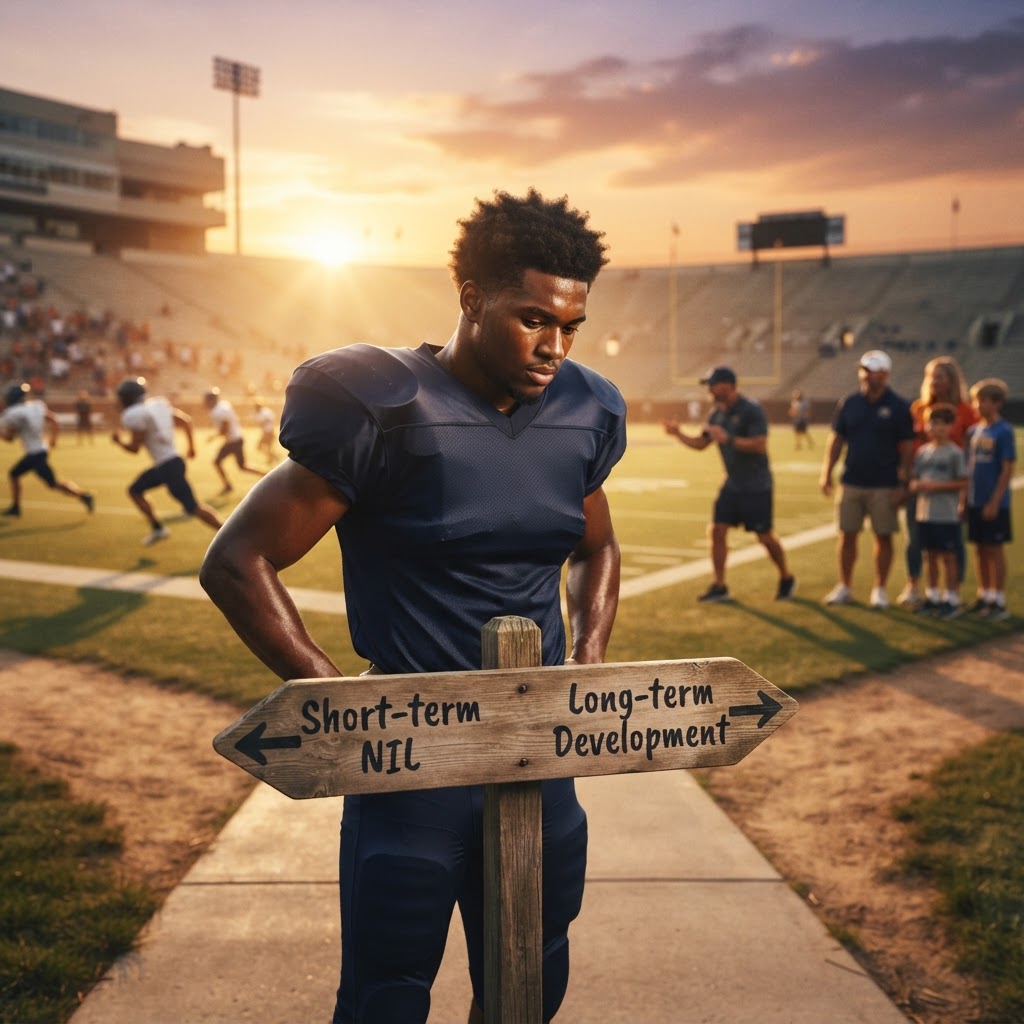
Editorial photograph for Navigating the 2026 NIL Landscape: Strategic Decisions for the Class of 2027 and Beyond
NIL News•2026-10-27•Trend 85.5/100

Navigating the 2026 NIL Landscape: Strategic Decisions for the Class of 2027 and Beyond

As the 2026 college football season progresses, the intersection of NIL, booster-led collectives, and recruiting has never been more complex. Families must prioritize long-term development over short-term gains.

The landscape of college football in October 2026 is defined by a sophisticated, high-stakes ecosystem where Name, Image, and Likeness (NIL) is no longer an auxiliary benefit but a central pillar of roster construction. Recent reporting from the College Sports Commission indicates that approximately 63% of all NIL agreements are now directly tied to school-affiliated sponsors and booster-operated collectives. For high school prospects in the Class of 2027 and their families, this data point is not merely a statistic; it is a fundamental shift in how recruiting decisions must be evaluated. As we move through the 2026 season, the pressure to secure financial commitments early has intensified, yet the most successful athletes remain those who view their collegiate tenure as a multi-year investment in their professional brand rather than a transactional payout. The modern recruit must balance the allure of immediate compensation with the reality of roster volatility, coaching stability, and the long-term value of a degree and professional development. When evaluating potential landing spots, families should look past the initial offer sheet and conduct rigorous due diligence on the sustainability of the program's NIL infrastructure. Are the funds coming from a stable, diversified collective, or are they reliant on a small group of donors whose interest may wane? Furthermore, the rise of revenue-sharing models following the House settlement has fundamentally altered the financial floor for student-athletes. With the cap for the 2026-27 school year set at $21.3 million, the financial landscape is more transparent but also more competitive. Athletes are increasingly encouraged by peers and mentors to prioritize 'opportunity before check size.' This means assessing the coaching staff's track record in player development, the strength of the program's media footprint, and the specific role the athlete will play in the team's offensive or defensive scheme. A high-dollar contract is of little value if the athlete is buried on the depth chart or if the program lacks the resources to showcase their talents on a national stage. Personal branding is another critical component. Athletes who treat their NIL as a business—engaging in professional content creation, understanding their own marketability, and maintaining a clean public image—are better positioned to secure third-party endorsements that exist outside of the booster-led collective ecosystem. This diversification is the ultimate hedge against the inherent risks of the transfer portal and coaching changes. Families should approach these decisions with a 'business-first' mindset, treating the recruitment process as a professional contract negotiation. This involves asking difficult questions about the longevity of NIL promises, the tax implications of various deal structures, and the legal protections afforded to the athlete in their agreements. It is essential to remember that while the numbers are larger than ever, the core of the college experience remains the same: the pursuit of excellence on the field and in the classroom. The most successful athletes in the current era are those who leverage their NIL to enhance their collegiate experience, not to replace the hard work required to reach the professional level. As you navigate the remainder of the 2026 cycle, maintain a focus on the long-term trajectory of your career. The financial landscape will continue to evolve, but the value of a well-developed brand

You’ve read 80%. Unlock the decisive ending free by email.
Editorial photograph for Strategic Partnerships and the Evolving NIL Landscape: A Guide for the Class of 2027 and Beyond
College NIL Deals•2026-10-26•Trend 85.5/100

Strategic Partnerships and the Evolving NIL Landscape: A Guide for the Class of 2027 and Beyond

As BYU announces a major partnership with PV3 Enterprises, athletes and families must navigate an increasingly complex NIL environment. Understanding how institutional strategy impacts individual branding is essential for the Class of 2027 and future recruits.

The landscape of college athletics in late 2026 is defined by a shift from individual, fragmented NIL opportunities toward sophisticated, institution-backed strategic partnerships. The recent announcement that BYU has entered into a strategic partnership with PV3 Enterprises to bolster its NIL program serves as a critical case study for high school athletes and their families. As we navigate the 2026 season, it is clear that the intersection of football recruiting, roster management, and commercial viability has reached a new level of complexity. For families of the Class of 2027 and beyond, understanding these institutional shifts is no longer optional; it is a fundamental requirement for making informed decisions about where to commit. When a university aligns with a third-party enterprise, it often signals a broader effort to professionalize the athlete experience, streamline compliance, and provide a more predictable financial environment. However, this also changes the nature of the recruiting conversation. Families must now evaluate not just the coaching staff or the facilities, but the robustness and sustainability of the school's NIL infrastructure. This involves asking difficult questions about how these partnerships function, who manages the relationships, and how the school balances collective-driven compensation with individual brand-building opportunities. In the current environment, the 'real love' a recruit feels during a visit—as seen in recent high-profile recruitments—must be balanced against the cold, hard reality of the business model supporting that program. Analysis of recent trends suggests that programs with clear, transparent, and well-funded NIL ecosystems are increasingly winning the battle for top-tier talent. This is not merely about the size of the initial offer; it is about the long-term stability of the support system. Athletes should look for programs that treat NIL as a core component of their athletic department's mission rather than an afterthought. This means evaluating the school's commitment to personal branding, financial literacy, and long-term career development. For the Class of 2027, the recruiting process is now a dual-track journey: one track focuses on athletic development and on-field performance, while the other focuses on the commercial and legal implications of the NIL landscape. Families should conduct thorough due diligence on any program they consider. This includes asking about the longevity of current NIL partnerships, the level of institutional support for athlete-led ventures, and the specific resources available to help athletes navigate tax and legal complexities. It is also vital to recognize that while institutional partnerships provide a baseline, an athlete's personal brand remains their most valuable asset. The most successful athletes are those who leverage the school's resources to amplify their own unique story, rather than relying solely on the school to provide opportunities. As you evaluate your options, consider the following practical steps to ensure you are making the best decision for your future. First, prioritize programs that demonstrate a clear, long-term vision for

You’ve read 80%. Unlock the decisive ending free by email.
Editorial photograph for Navigating the 2026 NIL Landscape: Legislative Shifts and Roster Realities
Sports Business•2026-10-25•Trend 92.5/100

Navigating the 2026 NIL Landscape: Legislative Shifts and Roster Realities

As the 2026 college football season progresses, legislative efforts like the Protect College Sports Act and evolving revenue-sharing models are reshaping how athletes in the Class of 2027 and beyond approach their financial futures.

The landscape of college athletics in October 2026 is defined by a tension between rapid commercial growth and the search for regulatory stability. Recent legislative activity, specifically the efforts by Senators Katie Britt and Tommy Tuberville to amend the Protect College Sports Act, highlights the ongoing struggle to standardize NIL compensation and revenue-sharing models. As of late 2026, the proposed amendments aim to establish a clearer framework for revenue-sharing, potentially setting caps that impact how schools and collectives distribute funds to both current roster members and incoming recruits. For families navigating the recruitment process, particularly those with athletes in the Class of 2027, these developments are not merely background noise; they are fundamental to understanding the long-term viability of scholarship and NIL packages. The current environment has moved beyond the 'Wild West' phase into a period of institutionalization, where multimedia rights partners and school-affiliated entities are increasingly scrutinized under the House settlement models. This shift means that the 'associated entity' model is becoming a standard, yet complex, component of how programs manage their multi-million dollar roster budgets. Athletes must recognize that the valuation of their NIL is now inextricably linked to these broader institutional financial strategies. When a program projects a roster spend exceeding $40 million, as seen in several SEC and Big Ten programs this season, the distribution of those funds is subject to strict internal and external compliance. For a high school recruit, this means that the 'offer' is no longer just a scholarship; it is a complex financial contract that requires rigorous due diligence. Families should be wary of verbal promises that do not align with the evolving legal requirements for revenue-sharing and NIL disclosure. The role of agents and advisors has also shifted; they are now tasked with navigating a landscape where tampering, rising prices for backup positions, and inconsistent eligibility guidance are common. Analysis of the current market suggests that while top-tier talent continues to command significant valuations—often reaching seven figures even for true freshmen—the sustainability of these payments is under pressure. Reports regarding the financial strain on entities like EA Sports due to rising NIL costs serve as a cautionary tale about the volatility of the market. Athletes should prioritize building a personal brand that exists independently of their immediate NIL deal, ensuring that their value is tied to their long-term marketability rather than just a short-term payout. Practical next steps for families involve a shift in focus from 'who pays the most' to 'who offers the most stable, compliant, and developmental environment.' Understanding the difference between a collective-driven payment and a legitimate revenue-sharing contract is essential. Families should ask pointed questions about the duration of these commitments, the tax implications of various deal

You’ve read 80%. Unlock the decisive ending free by email.
Editorial photograph for Navigating the $1.77 Billion Landscape: A Guide for the Class of 2027 and Beyond
College NIL Deals•2026-10-24•Trend 95.5/100

Navigating the $1.77 Billion Landscape: A Guide for the Class of 2027 and Beyond

As college football enters a new era of direct revenue sharing, athletes and families must adapt their recruiting strategies to a landscape where over $1.77 billion is flowing into rosters. Understanding the legal and financial shifts of 2026 is essential for long-term success.

The landscape of college football has undergone a seismic shift as of October 2026. With the College Sports Commission reporting over $227 million in cleared deals since July and total direct revenue-sharing payments across the sport reaching an estimated $1.77 billion, the financial stakes for high school recruits have never been higher. For families navigating the recruiting process for the Class of 2027 and the Class of 2028, the traditional model of simply chasing a scholarship offer is obsolete. Today, the conversation must encompass revenue sharing, institutional NIL entities, and the long-term sustainability of a program's financial commitment. Confirmed reporting from the College Sports Commission and recent legal developments regarding the House settlement indicate that the 'associated entity' model is here to stay. This means that schools are increasingly integrating NIL-generating entities directly into their athletic departments. While this provides a more structured environment for athletes, it also creates a complex web of contracts that families must navigate with extreme caution. The days of informal, handshake-based NIL agreements are fading, replaced by formal contracts that require professional review. When evaluating a program, families should look beyond the initial dollar figure. The real question is the stability of the funding source. Is the money coming from a sustainable revenue-sharing pool, or is it reliant on volatile booster-led collectives? As noted in recent industry analysis, some programs are pushing every available dollar into their rosters, which has led to a cooling of the coaching carousel as buyouts become secondary to player compensation. This 'unfireable coach' phenomenon, driven by the need to prioritize roster spending, suggests that the financial health of a football program is now inextricably linked to its ability to retain talent through competitive compensation packages. For the Class of 2027, this means that your personal brand is no longer just a side project; it is a core component of your professional value. Athletes must conduct rigorous due diligence. Before committing to a school, ask for clarity on how the revenue-sharing model functions at that specific institution. Understand the difference between guaranteed compensation and performance-based incentives. Furthermore, be wary of recruiting inducements that promise future earnings without a clear, legally binding framework. The current regulatory environment is fragmented, and as figures like Nick Saban have advocated, there is a desperate need for a unified federal framework to protect athletes from predatory practices. Until such a framework is fully realized, the burden of protection falls on the athlete and their family. Personal branding remains a vital tool, but it must be built on a foundation of authentic engagement rather than just chasing the highest bidder. A strong brand can provide value long after your playing days are over, whereas a short-sighted NIL deal can lock you into unfavorable terms that limit your future flexibility. When considering your next steps, prioritize programs that demonstrate transparency in their financial operations. Look for coaching staffs that are willing to discuss the 'business' side of the program openly. If a school is hesitant to explain how their NIL and revenue-sharing ecosystem

You’ve read 80%. Unlock the decisive ending free by email.

Editorial photograph for Navigating the 2026 NIL Landscape: Strategic Insights for the Class of 2027 and Class of 2028
College NIL Deals•2026-10-20•Trend 85.5/100

Navigating the 2026 NIL Landscape: Strategic Insights for the Class of 2027 and Class of 2028

As major brands like Nike and Venmo expand their high school NIL portfolios, athletes in the Class of 2027 and Class of 2028 must balance immediate financial opportunities with long-term roster strategy and professional development.

The landscape of college football recruiting has shifted dramatically by October 2026. With major brands like Nike actively signing elite prospects from the Class of 2027 and Class of 2028, and platforms like Venmo integrating athletes into national campaigns, the intersection of personal branding and athletic recruitment has never been more complex. For families navigating this environment, the challenge is no longer just about securing a scholarship; it is about managing a professional-grade business portfolio while maintaining focus on academic and athletic growth. Recent reporting from On3 highlights that high-profile recruits, such as USC commit Quentin Hale, are increasingly securing partnerships with global brands well before they step onto a college campus. This trend signals a shift where national marketability is becoming a core component of a recruit's profile. However, these opportunities bring significant responsibilities. Athletes and their families must approach these deals with the same rigor they apply to their recruitment process. This involves understanding the long-term implications of brand alignment, the tax considerations of NIL income, and the potential impact on future roster flexibility. The regulatory environment remains fluid, particularly following executive actions in early 2026 aimed at standardizing transfer limits and eligibility. Families should prioritize due diligence, ensuring that any NIL agreement does not inadvertently conflict with institutional policies or future NCAA eligibility requirements. When evaluating a potential partnership, consider the brand's long-term commitment to the athlete's personal development versus a short-term transactional payout. A brand that aligns with an athlete's personal values and long-term career goals is often more valuable than a one-off payment. Furthermore, roster strategy is paramount. As collectives and athletic departments continue to evolve their funding models, recruits must consider how their NIL valuation fits into the broader team structure. A high-profile NIL deal can be a powerful tool for personal branding, but it should not overshadow the primary goal of finding a program that offers the best developmental path for the athlete's professional aspirations. Families should engage in open, transparent conversations with coaching staffs about how NIL opportunities are integrated into the team culture. It is essential to distinguish between confirmed reporting and speculative market trends. While the headlines often focus on the largest dollar amounts, the most sustainable success comes from building a brand that is authentic to the athlete. Practical next steps for families include establishing a professional support team, maintaining strict academic standards, and focusing on consistent on-field performance. The goal is to build a foundation that supports the athlete throughout their collegiate career and beyond. As the industry continues to mature, the ability to navigate these financial and professional waters will be a key differentiator for the next generation of college football stars. By focusing on long-term value, strategic brand alignment, and clear communication with coaching staffs, athletes can leverage the current NIL environment to enhance their overall collegiate experience. The following checklist provides a framework for

You’ve read 80%. Unlock the decisive ending free by email.
Editorial photograph for The New Era of Revenue Sharing: Navigating NIL in the Class of 2026 and Beyond
Sports Business•2026-10-16•Trend 95.5/100

The New Era of Revenue Sharing: Navigating NIL in the Class of 2026 and Beyond

As the SEC implements uniform NIL and revenue-sharing contracts, the landscape for the Class of 2026 and future recruits has shifted. We break down what this means for athlete families, roster strategy, and the future of college football compensation.

The landscape of college football is undergoing its most significant transformation since the inception of Name, Image, and Likeness (NIL) rights. As of October 2026, the recent move by SEC presidents to approve a uniform NIL and revenue-sharing contract structure marks a pivotal shift in how programs recruit, retain, and compensate talent. For families of athletes in the Class of 2026 and beyond, this development is not just a headline—it is a fundamental change in the business of collegiate athletics. The era of 'wild west' NIL collectives is rapidly transitioning into a more structured, albeit complex, environment where revenue sharing is becoming the standard rather than the exception. This shift directly impacts how high school prospects evaluate their future homes. When a program offers a standardized revenue-sharing model, it provides a level of transparency that was previously absent. However, it also introduces new layers of contractual obligation. Families must now look beyond the initial 'offer' and understand the long-term implications of these agreements. Are these contracts tied to performance metrics? Do they include clawback provisions? How does the revenue-sharing model interact with traditional scholarship packages? These are the questions that define the modern recruiting process. From a roster strategy perspective, coaches are now operating more like professional general managers. They are balancing salary caps, revenue-sharing pools, and the need to maintain a competitive locker room culture. For a recruit, this means your value is no longer just about your highlight reel; it is about your fit within a specific financial ecosystem. If a program is allocating a significant portion of its budget to a veteran starter, how does that impact the development and compensation of a freshman? Understanding the 'depth chart' of a program’s payroll is now as important as understanding the depth chart of the team itself. Personal branding remains a critical component of an athlete's financial success. While revenue sharing provides a baseline, the most successful athletes will continue to be those who leverage their personal brand to secure third-party endorsements. The best NIL strategy is a hybrid one: a stable foundation provided by the university’s revenue-sharing model, supplemented by high-value, authentic partnerships that build long-term equity. Families should approach this by conducting rigorous due diligence. Do not rely solely on verbal promises made during a home visit. Demand to see the structure of the NIL opportunities and understand the legal framework governing the collective. If a program is hesitant to provide clarity on how their revenue-sharing model functions, that is a red flag. The goal is to align with a program that views

You’ve read 80%. Unlock the decisive ending free by email.

Editorial photograph for Navigating the 2026 NIL Landscape: Strategic Insights for the Class of 2027 and Beyond
Sports Business•2026-10-13•Trend 85.5/100

Navigating the 2026 NIL Landscape: Strategic Insights for the Class of 2027 and Beyond

As the 2026 college football season progresses, recent legislative efforts and shifting investment patterns highlight the need for families to prioritize long-term financial literacy and roster stability over immediate NIL promises.

The current college football landscape in October 2026 is defined by a complex intersection of legislative uncertainty and evolving corporate investment strategies. Recent reporting from On3 highlights that Big Ten leadership remains optimistic regarding the 'Protect College Sports Act,' a legislative effort aimed at stabilizing the chaotic NIL environment that figures like Nick Saban have previously warned is unsustainable. For families navigating the recruiting process, particularly those with prospects in the Class of 2027 and beyond, understanding these macro-level shifts is essential for making informed decisions. The reality of the 2026 season is that NIL dollars are increasingly being funneled toward roster retention and the transfer portal rather than solely high school recruiting. This shift represents a fundamental change in how programs allocate their limited resources. When a program commits significant capital to retain veteran talent, it inherently changes the financial outlook for incoming freshmen. Families must conduct rigorous due diligence, looking past the 'sticker price' of an initial NIL offer to understand the sustainability of that compensation. A contract is only as valuable as the collective or institutional stability behind it. Personal branding remains a critical component of an athlete's financial portfolio, but it should be viewed as a supplement to, not a replacement for, a sound academic and athletic development plan. Athletes should focus on building a brand that transcends their specific university, ensuring that their market value remains resilient even if they choose to enter the transfer portal later in their careers. Financial questions should be at the forefront of every recruiting visit. Families should ask coaches and collective representatives about the longevity of their NIL programs, the specific metrics used to determine compensation, and how the program balances the needs of veteran starters with the development of incoming recruits. It is vital to distinguish between guaranteed compensation and performance-based incentives, as the latter carries inherent risks that are often downplayed during the recruitment phase. Furthermore, roster strategy is a key indicator of a program's health. If a team is heavily reliant on the transfer portal to fill gaps, it may signal a lack of long-term development, which could impact a recruit's playing time and, consequently, their NIL earning potential. Athletes should prioritize programs that demonstrate a commitment to developing their own talent, as this provides a more stable foundation for both athletic success and long-term financial growth. Practical next steps for families involve creating a comprehensive 'NIL Audit' for every school under consideration. This audit should include an assessment of the local market, the strength of the school's alumni network, and the transparency of the collective's operations. Avoid making decisions based

You’ve read 80%. Unlock the decisive ending free by email.
Editorial photograph for Navigating the SEC Flip Culture: A Guide for the Class of 2027 and Beyond
College NIL Deals•2026-10-10•Trend 88.5/100

Navigating the SEC Flip Culture: A Guide for the Class of 2027 and Beyond

As LSU and other SEC programs aggressively pursue late-cycle flips, families must understand the shifting landscape of modern recruiting. We break down how to protect your interests in the Class of 2027.

In the current landscape of college football, the traditional concept of a 'commitment' has evolved into a fluid, ongoing negotiation. Recent reporting from Rivals highlights that LSU is once again aggressively tracking for a high-profile SEC flip, targeting a touted defensive back in the Class of 2027. This development serves as a critical reminder for student-athletes and their families: the recruiting process does not end when a verbal pledge is made. In the era of the transfer portal and sophisticated NIL collectives, the pressure to secure talent often leads programs to pursue committed prospects until the final ink is dry on a National Letter of Intent. For families in the Class of 2027 and the Class of 2028, this environment requires a shift in mindset from passive participants to active managers of a professional brand. Confirmed reporting indicates that elite programs are increasingly utilizing 'PR wars' and on-field performance metrics to sway recruits who have already pledged elsewhere. This strategy is designed to create doubt in the recruit's mind regarding their current choice, forcing them to re-evaluate their fit, their potential for early playing time, and the financial upside of their NIL package. When a program like LSU or any other major SEC contender initiates a flip, they are not just selling a football program; they are selling a comprehensive ecosystem of exposure, development, and financial opportunity. For the athlete, this creates a complex dilemma. On one hand, the attention is validating. On the other, it introduces significant instability. Families must conduct rigorous due diligence. This means looking beyond the initial offer and examining the long-term roster strategy of the coaching staff. Is the program recruiting over your position? How does the current NIL collective structure support players at your specific spot on the depth chart? These are not just football questions; they are business questions. Personal branding is also a major factor. A flip is a high-stakes public relations move. Athletes must consider how a change in commitment will be perceived by fans, media, and future professional scouts. While the decision is ultimately the athlete's, the family must act as a board of directors, ensuring that every move aligns with the athlete's long-term career goals rather than short-term emotional impulses. Practical next steps involve maintaining open, honest communication with the coaching staff of the school you are currently committed to, while also keeping a professional distance from programs attempting to initiate a flip. Do not allow the pressure of a 'recruiting battle' to cloud your judgment. Focus on the data: graduation rates, development history, and the actual, verifiable NIL support provided to players in your position. Remember that a commitment is a two-way street, and

You’ve read 80%. Unlock the decisive ending free by email.
Editorial photograph for Navigating the New Financial Landscape: NIL Negotiations for the Class of 2026 and Beyond
College NIL Deals•2026-10-04•Trend 95.5/100

Navigating the New Financial Landscape: NIL Negotiations for the Class of 2026 and Beyond

As the Class of 2026 navigates an evolving collegiate landscape defined by revenue sharing and complex NIL negotiations, athletes and families must prioritize due diligence, brand authenticity, and long-term financial literacy to succeed in the modern era.

The landscape of collegiate athletics has undergone a seismic shift by October 2026. With the arrival of revenue sharing and the maturation of Name, Image, and Likeness (NIL) collectives, the recruitment process for the Class of 2026 and subsequent cycles has moved far beyond simple scholarship offers. Today, high-level recruits are not just evaluating coaching staffs and facilities; they are effectively entering into sophisticated business negotiations that mirror professional sports. Recent reporting from On3 highlights that top recruits are increasingly vocal about how they manage these NIL discussions, emphasizing that the ability to navigate these conversations is now a prerequisite for success at the highest levels of college football. For families, this transition requires a fundamental change in mindset. The days of relying solely on a recruiter's promise are over. Instead, families must approach the recruitment process with the rigor of a business transaction, focusing on transparency, contractual clarity, and the long-term viability of the programs they are considering. The integration of revenue sharing into the college model means that the financial floor for student-athletes has risen, but it has also introduced new layers of complexity regarding how compensation is structured, taxed, and reported. Athletes in the Class of 2026 must understand that their personal brand is an asset that requires active management. This involves more than just social media presence; it requires a strategic approach to partnerships that align with their long-term career goals, whether those goals involve a professional football career or a transition into the corporate world. Families should be wary of 'guaranteed' figures that lack contractual backing. Due diligence is the most critical tool in a family's arsenal. This means asking difficult questions: Who is funding the collective? What are the specific performance benchmarks, if any? How does the school's internal NIL unit interact with third-party collectives? Understanding the distinction between institutional support and independent collective funding is vital for assessing the stability of a program's financial commitment. Furthermore, roster strategy has become inextricably linked to NIL. Coaches are now managing salary caps of sorts, balancing the need for veteran talent with the desire to bring in elite prospects from the Class of 2026. Athletes should inquire about how their potential NIL package fits into the broader team budget and what the expectations are for their role within the program. A player who understands their value proposition—not just as a talent on the field, but as a marketable entity—will be better positioned to negotiate favorable terms. Personal branding should be viewed as a marathon, not a sprint. While the immediate allure of a large NIL deal is understandable, the most successful athletes are those who build a sustainable brand that can survive the volatility of the college sports market. This includes diversifying income streams, protecting intellectual property, and surrounding themselves with a trusted team of advisors who prioritize the athlete's long-term well-being over short-term gains. As we look toward the future

You’ve read 80%. Unlock the decisive ending free by email.
Editorial photograph for Navigating the 2026 Landscape: Why NIL Due Diligence is the New Recruiting Baseline
Sports Business•2026-10-03•Trend 8.5/100

Navigating the 2026 Landscape: Why NIL Due Diligence is the New Recruiting Baseline

As the 2026 college football season hits its stride, recent reports of contract litigation highlight the critical need for families to treat NIL agreements with the same scrutiny as professional business contracts.

As of October 2026, the landscape of college football recruiting has shifted from a focus on simple scholarship offers to a complex ecosystem of revenue sharing and Name, Image, and Likeness (NIL) negotiations. Recent reporting from On3 has highlighted the growing friction in this space, specifically regarding the legal complexities of NIL contracts and the potential for litigation when expectations between institutions and athletes diverge. For families navigating the Class of 2027 and beyond, these developments serve as a stark reminder that the recruiting process is no longer just about athletic development; it is about entering into binding, high-stakes commercial agreements. Confirmed reporting indicates that institutions are increasingly willing to pursue legal remedies when they believe contractual obligations—such as licensing fees or promotional requirements—are not met by student-athletes. This shift underscores a fundamental change in the power dynamic of college sports. In the past, the relationship between a player and a university was largely governed by the scholarship agreement and NCAA compliance. Today, that relationship is layered with commercial contracts that carry real-world financial consequences. For a recruit in the Class of 2027, the decision-making process must now incorporate a rigorous assessment of the school's internal NIL infrastructure. Families should be asking: Who manages the NIL collective? What are the specific deliverables required in the contract? Is there a clear exit strategy if the coaching staff changes or the athlete enters the transfer portal? The era of 'handshake deals' is effectively over. When evaluating a program, families must look beyond the flashy social media graphics and the promise of a starting position. They must conduct due diligence on the financial stability of the school's NIL partners. If a program is currently involved in litigation or has a history of delayed payments, that is a red flag that requires immediate attention. Furthermore, personal branding has become a critical component of roster strategy. Coaches are now looking for players who not only fit their scheme but also understand the value of their own brand. An athlete who can articulate their market value and manage their professional obligations is a more attractive prospect than one who relies solely on the collective to handle their business. This requires a shift in mindset for parents and athletes alike. You are not just a student-athlete; you are a business entity. This means maintaining a professional standard in all public-facing activities and ensuring that any NIL agreement is reviewed by someone with experience in contract law. Do not rely on the verbal assurances of recruiters who may not be in the same position two years from now. The volatility of the current college football environment—marked by frequent coaching changes and roster turnover—means that your NIL contract is often the only thing that provides a measure of financial security. If a contract is poorly drafted or lacks clear language regarding what happens in the event of a transfer or injury, the athlete is the one who bears the risk. Families should prioritize transparency and seek to understand the 'why' behind every clause in a proposed agreement. If a school is hesitant to provide a written contract or refuses to explain the specific deliverables, that is a signal to pause and re-evaluate the commitment. The goal is to align with a program that views the athlete as a long-term partner rather than a short-term asset. By treating the recruiting process as a professional business negotiation, families can protect their interests and ensure that the athlete's transition to the collegiate level is built on a foundation of clarity and mutual respect. The future of college football is

You’ve read 80%. Unlock the decisive ending free by email.

Editorial photograph for Navigating the 2026 NIL Landscape: Strategic Insights for the Class of 2026 and Beyond
College NIL Deals•2026-09-30•Trend 85.5/100

Navigating the 2026 NIL Landscape: Strategic Insights for the Class of 2026 and Beyond

As the 2026 college football season hits its stride, major brands like Venmo are formalizing athlete partnerships. We analyze how these developments impact recruiting, personal branding, and the financial due diligence required for families in the Class of 2026.

The landscape of Name, Image, and Likeness (NIL) in college football has evolved from a chaotic frontier into a sophisticated ecosystem of corporate partnerships and strategic roster management. As of September 2026, we are seeing a clear trend: major national brands are moving away from one-off social media posts toward structured, multi-athlete campaigns. A prime example is the recent announcement by Venmo regarding its 2026 class of NIL athletes, which spans multiple sports and emphasizes community impact and personal brand alignment [5]. For families and athletes in the Class of 2026 and beyond, this shift represents a fundamental change in how value is perceived and how recruitment decisions should be evaluated. When a brand like Venmo or Adidas—which recently signed Miami receiver Malachi Toney [10]—invests in a student-athlete, they are not just paying for a logo on a jersey; they are betting on the athlete's long-term marketability and professional conduct. This requires a shift in mindset for high school recruits. You are no longer just a football player; you are a small business entity. The due diligence process for a family now involves looking beyond the scholarship offer to understand the 'NIL culture' of a program. Does the university have the infrastructure to support these high-level brand partnerships? Are there internal collectives or external agencies that provide the necessary legal and tax guidance to manage these contracts? These are the questions that should be at the forefront of every recruiting visit. Confirmed reporting indicates that NIL negotiations have become a standard component of the recruitment process for the Class of 2026 [4]. General managers and NIL staffers at Power Four programs are now essentially acting as talent agents, balancing the need to retain top-tier talent with the constraints of a salary-cap-like environment. This has direct implications for roster strategy. If a program is heavily invested in high-dollar NIL deals for a few stars, how does that impact the depth of the roster? Families must weigh the allure of a large upfront NIL package against the stability of a program that prioritizes development and long-term professional growth. Personal branding is the engine that drives these opportunities. Athletes who cultivate an authentic voice and engage with their communities—as seen in the 'Money Moves' campaign [5]—are significantly more attractive to national brands than those who rely solely on on-field performance. This is not about vanity; it is about building a portfolio that survives the transition from college to the professional ranks. Practical next steps for families include establishing a professional team early. This does not necessarily mean hiring an expensive agent immediately, but it does mean consulting with trusted financial and legal advisors who understand the

You’ve read 80%. Unlock the decisive ending free by email.
Editorial photograph for Navigating the 2026 NIL Landscape: Strategic Due Diligence for the Class of 2027 and Beyond
College NIL Deals•2026-09-28•Trend 85.5/100

Navigating the 2026 NIL Landscape: Strategic Due Diligence for the Class of 2027 and Beyond

As the 2026 college football season intensifies, the intersection of NIL rights and roster management has reached a critical inflection point. For families of the Class of 2027, understanding the shift from simple endorsements to complex commercial partnerships is essential for long-term success.

The landscape of college athletics in September 2026 is defined by a sophisticated, high-stakes commercial environment that would have been unrecognizable just a few years ago. Recent reporting from On3 and industry analysts highlights that the era of 'simple' NIL deals has been replaced by a complex ecosystem of collectives, multimedia rights partners, and professionalized branding strategies. As we move through the 2026 season, the primary challenge for high school prospects in the Class of 2027 is no longer just securing an offer, but understanding the financial and contractual architecture behind the programs they are considering. The recent scrutiny regarding 'warehousing'—where entities attempt to purchase NIL rights without active marketing—serves as a stark reminder that not all agreements are created equal. For families, the focus must shift from the total dollar amount of a potential deal to the sustainability and legality of the structure. When evaluating a program, families should look beyond the surface-level promises of NIL compensation. True due diligence involves asking how a school’s collective operates, whether they prioritize active brand building or passive compensation, and how these agreements align with the athlete's long-term professional goals. The integration of NIL into the recruiting process means that a player's personal brand is now a core component of their roster value. Athletes who treat their recruitment as a business partnership rather than a passive acceptance of an offer are better positioned to navigate the inevitable volatility of the college sports market. Analysis of current trends suggests that programs with transparent, well-integrated NIL strategies are seeing higher retention rates and more cohesive locker rooms. Conversely, programs that rely on unsustainable, short-term financial incentives often face significant roster turnover when those promises fail to materialize or when the regulatory environment shifts. For the Class of 2027, the practical next step is to build a team of trusted advisors—not just agents, but mentors who understand the intersection of academic eligibility, personal branding, and contractual law. It is vital to remember that an NIL contract is a legal document with long-term implications. Families should never sign an agreement without independent review, and they should be wary of any entity that discourages transparency or legal oversight. The goal is to build a foundation that supports the athlete both on the field and in the marketplace, ensuring that their time in college serves as a launchpad for their future, whether that includes professional sports or a career in another field. As the 2026 season progresses, the gap between programs that have mastered the NIL ecosystem and those that are still struggling to adapt will only widen. Families must prioritize programs that demonstrate a commitment to the holistic development of the student-athlete, where NIL is a tool for empowerment rather than a distraction from the primary goals of education and athletic excellence. By focusing on long-term value, sustainable partnerships, and rigorous due diligence, the Class of 2027 can navigate this complex environment with confidence and clarity. Recruiting Action Checklist: 1. Conduct a thorough audit of the

You’ve read 80%. Unlock the decisive ending free by email.
Editorial photograph for Navigating the NIL Landscape: Lessons from the 2026 Venmo 'Money Moves' Campaign
College NIL Deals•2026-09-27•Trend 85.5/100

Navigating the NIL Landscape: Lessons from the 2026 Venmo 'Money Moves' Campaign

As the 2026 college football season progresses, major brand partnerships like Venmo's 'Money Moves' campaign highlight the evolving nature of athlete branding. We explore how these developments impact the Class of 2027 and beyond, focusing on due diligence and long-term financial strategy.

In the rapidly shifting ecosystem of collegiate athletics, the intersection of personal branding and financial responsibility has never been more critical. As of September 2026, the landscape of Name, Image, and Likeness (NIL) has matured from a chaotic gold rush into a more structured, albeit complex, business environment. Recent developments, such as the expansion of Venmo’s 'Money Moves' campaign, which brought nine new athletes into its fold this September, serve as a bellwether for how student-athletes should approach their professional trajectory. For families navigating the recruitment process for the Class of 2027 and beyond, understanding these shifts is not merely an advantage—it is a necessity for long-term stability. The 'Money Moves' initiative is particularly instructive because it emphasizes community impact and structured brand alignment rather than just transactional payouts. This shift suggests that brands are increasingly looking for athletes who can demonstrate authentic engagement and long-term value, a lesson that should be at the forefront of every recruit's mind. When evaluating potential NIL opportunities, athletes must look beyond the immediate dollar amount and consider the reputational footprint they are creating. A partnership that aligns with an athlete's personal values and long-term career goals is significantly more valuable than a one-off deal that offers quick cash but lacks strategic depth. This is especially relevant for high-school prospects who are currently building their personal brands while simultaneously managing the pressures of the recruiting trail. The financial stakes are high, and the legal complexities are growing. As reported by On3, universities are increasingly utilizing 'liquidated damages' clauses in NIL contracts to protect their interests in the event of a transfer, a trend that underscores the importance of reading the fine print. Families must conduct rigorous due diligence before signing any agreement. This includes consulting with independent legal and financial professionals who are not affiliated with the university or the collective. Relying solely on the guidance provided by those with a vested interest in the athlete's commitment can lead to significant blind spots. Furthermore, the integration of NIL into the broader roster strategy means that an athlete's financial profile is now inextricably linked to their athletic performance and team standing. Coaches are looking for players who can handle the professional demands of the modern game, and the ability to manage NIL obligations with maturity is a key indicator of a player's readiness for the next level. Athletes should view their NIL activities as a business internship, where the goal is to build a portfolio of professional experiences that will serve them well beyond their playing days. This requires a disciplined approach to time management, communication, and brand stewardship. For the Class of 2027, the recruiting process is no longer just about finding the right scheme or the best coaching staff; it is about finding an environment that supports the holistic development of the athlete as a professional. Families should ask tough questions during official visits: How does the program support NIL education? What resources are available for financial literacy? How does the coaching staff view the balance between athletic commitments and personal brand building? These questions are just as important as those regarding playing time or academic support. The reality of the current market is that while opportunities are abundant, the risks are equally significant. Unreported third-party deals and complex clearinghouse requirements, as highlighted by recent College Sports Commission reports, demonstrate that the regulatory environment is tightening. Athletes who fail to adhere to these standards risk not only their eligibility but also their future professional prospects. Therefore, transparency and compliance must be

You’ve read 80%. Unlock the decisive ending free by email.
Editorial photograph for Navigating the New Era: NIL Realities for the Class of 2026 and Beyond
College NIL Deals•2026-09-26•Trend 85.5/100

Navigating the New Era: NIL Realities for the Class of 2026 and Beyond

As the 2026 college football season progresses, the landscape of NIL and recruiting has shifted toward institutional partnerships and professionalized branding. Families must adapt to these changes to ensure long-term success.

The landscape of college football recruiting in September 2026 is fundamentally different from the era of fax machines and handshake promises. As we move through the current season, the integration of Name, Image, and Likeness (NIL) into the core of athletic departments has transformed from a chaotic 'Wild West' into a structured, albeit complex, business environment. Recent reporting from On3 highlights that while high-profile NIL battles continue to dominate headlines, the most sustainable success for programs—and by extension, the athletes they recruit—is increasingly found in institutional partnerships and strategic brand management rather than just being the highest bidder. For families navigating the recruitment of the Class of 2026, understanding this shift is critical. The days of viewing NIL as a simple transaction are over; it is now a multi-year professional development strategy. Programs are now leveraging massive corporate partnerships, such as the recent expansion of Nike’s Blue Ribbon Elite program, to provide athletes with structured, reliable compensation models. This move toward institutionalized NIL means that recruits must evaluate not just the immediate dollar amount offered by a collective, but the long-term value of the brand ecosystem a university provides. When evaluating a school, families should look past the initial offer sheet. Ask the coaching staff and compliance officers about their specific NIL infrastructure. Does the school have a dedicated staff to help with tax preparation, contract review, and personal branding? Are there existing partnerships with major apparel or tech companies that provide a platform for the athlete to grow their own marketability? These questions are no longer optional; they are essential due diligence. The financial reality for the Class of 2026 is that roster strategy is now inextricably linked to the salary cap-like constraints of modern college athletics. Coaches are managing budgets that must account for both high-impact transfers and incoming high school talent. This means that an athlete’s personal brand is a significant asset in their recruitment. If an athlete can demonstrate an ability to drive engagement or represent a brand professionally, they become more valuable to the program’s overall NIL strategy. This is not about being a social media influencer; it is about understanding the business of sports. Athletes should begin treating their recruitment as a professional interview process. This involves maintaining a clean digital footprint, understanding the basics of contract law, and being prepared to discuss their own value proposition. Families should be wary of any entity promising guaranteed outcomes or massive payouts without a clear, transparent contract. Always consult with independent, qualified professionals—not just those provided by the school—when reviewing any binding agreements. The goal is to build a foundation that supports the athlete’s growth both on the field and in the marketplace. As we look at the current state of the 2026 cycle, the most successful athletes are those who view their college career as the first step in a professional journey. They are not just looking for a place to play; they are looking for a partner in their development. By focusing on the quality of the support system, the strength of the university’s brand, and the long-term viability of their NIL opportunities, families can make informed decisions that protect the athlete’s future. The transition from high school to college is a major life event, and in 2026, it requires a business-minded approach to ensure that the athlete is positioned for success long after their final snap. Recruiting Action Checklist: 1. Audit

You’ve read 80%. Unlock the decisive ending free by email.
Editorial photograph for Navigating the 2026 NIL Landscape: Strategic Insights for the Class of 2027 and Beyond
Sports Business•2026-09-25•Trend 95.5/100

Navigating the 2026 NIL Landscape: Strategic Insights for the Class of 2027 and Beyond

As the 2026 college football season intensifies, recent developments regarding NIL spending and roster management highlight the need for families to prioritize long-term financial literacy and brand development over short-term gains.

The landscape of college athletics in September 2026 is defined by a shift toward institutionalized financial structures. With recent reports indicating that major programs like Nebraska are aggressively recalibrating their NIL spending to reach the 'top third' of the Big Ten, and NCAA leadership expressing concerns about roster stability, the environment for high school recruits in the Class of 2027 and the Class of 2028 has never been more complex. As families navigate the recruiting process, understanding the distinction between speculative NIL promises and sustainable, long-term financial health is paramount. Recent reporting from On3 highlights that athletic departments are increasingly focused on competitive parity, with some institutions facing significant budgetary pressures, such as the projected $26 million deficit at LSU. This financial reality directly impacts how collectives and athletic departments approach recruitment. For a student-athlete in the Class of 2027, the allure of a high-dollar initial offer must be weighed against the stability of the program, the quality of the coaching staff, and the actual marketability of their personal brand. Personal branding is no longer just about social media followers; it is about building a professional identity that translates into value for corporate partners. When evaluating potential destinations, families should look beyond the immediate NIL package. Ask questions about the longevity of the collective, the university's commitment to group licensing, and the educational resources provided to help athletes manage their taxes and financial planning. The recent trend of high-profile athletes securing six-figure deals with major apparel brands, such as the recent agreement involving Louisville quarterback Lincoln Kienholz, demonstrates that individual marketability remains a powerful tool. However, these opportunities are often the result of years of consistent performance and strategic brand management. Families should view NIL as a component of a broader career strategy rather than the primary driver of a college commitment. Roster strategy is another critical factor. With the NCAA and university leadership warning about the impact of transfer portal activity and the return of professional athletes to the collegiate level, recruits must consider how their chosen school manages its roster. A school that relies heavily on the portal may offer less long-term development for a high school recruit compared to a program that prioritizes internal growth. Due diligence is the most effective defense against future disappointment. Before signing any agreement, families should ensure they understand the terms of the contract, the expectations for appearances, and the tax implications of their compensation. It is essential to consult with independent financial and legal professionals who are not affiliated with the school or the collective. The goal is to ensure that the athlete's financial interests are protected and that the NIL arrangement supports, rather than hinders, their academic and athletic progress. As we move through the 2026 season, the focus for families should remain on the 'big picture.' A successful college

You’ve read 80%. Unlock the decisive ending free by email.
Editorial photograph for Navigating the NIL Landscape: Lessons from the SEC Recruiting Surge for the Class of 2027 and Beyond
NIL News•2026-09-23•Trend 92.5/100

Navigating the NIL Landscape: Lessons from the SEC Recruiting Surge for the Class of 2027 and Beyond

As SEC programs like Ole Miss capitalize on early-season momentum to secure top-tier talent, families must understand how NIL clearinghouse data and institutional investment strategies impact the recruitment of the Class of 2027 and Class of 2028.

The landscape of college football recruiting in September 2026 is defined by a high-stakes intersection of on-field performance and institutional financial strategy. Recent reporting from On3 highlights a significant surge in recruiting momentum for programs like Ole Miss, which is actively leveraging high-profile victories to solidify their standing with elite prospects. For families navigating the recruitment of the Class of 2027 and Class of 2028, this environment requires a shift in perspective: recruitment is no longer just about coaching relationships and facilities; it is about understanding the financial ecosystem of the university. Recent data from the College Sports Commission indicates that the NIL Go clearinghouse has processed over $355 million in deals since its inception, with a notable uptick in activity during the summer of 2026. This volume of capital moving through the system underscores that NIL is not merely a peripheral benefit but a core component of roster construction. When a program like Ole Miss or Nebraska—which recently signaled a goal to reach the 'top third' of Big Ten NIL spending—pushes for a commitment, they are often presenting a holistic package that includes projected NIL opportunities alongside traditional scholarship benefits. For the athlete, this necessitates a rigorous due diligence process. Families must distinguish between 'market-value' NIL opportunities, which are tied to an athlete's personal brand and influence, and 'institutional' NIL, which is often facilitated through collective partnerships. Understanding this distinction is vital for long-term financial planning. If an athlete commits based on a verbal promise of NIL compensation, that agreement must be scrutinized with the same level of care as a professional contract. It is essential to ask: Is this compensation guaranteed? What are the performance or availability requirements? How does this impact the athlete's tax liability? Furthermore, the 'portal era' has fundamentally changed roster strategy. Coaches are now balancing the development of high school recruits in the Class of 2027 with the immediate need to fill gaps via the transfer portal. This means that a high school recruit's value is often weighed against the cost and immediate impact of a veteran transfer. Athletes should prioritize programs that demonstrate a clear, documented commitment to player development, as this remains the most reliable path to long-term NIL valuation. Personal branding is the final piece of the puzzle. While institutional NIL provides a baseline, the athletes who thrive are those who treat their brand as a business. This involves understanding social media engagement, community involvement, and the legal implications of endorsement contracts. Families should avoid the temptation to chase the highest immediate offer, as short-term gains can sometimes come at the expense of long-term development or roster stability. Instead, focus on the 'fit'—the alignment between the coaching staff's vision, the program's financial health, and the athlete's personal and professional goals. As we move through the 2026 season, the gap between programs that effectively manage their NIL infrastructure and those that lag behind will only widen. Families must remain vigilant, informed, and proactive in their approach to the recruiting

You’ve read 80%. Unlock the decisive ending free by email.

Editorial photograph for The Evolution of NIL: Lessons from the Class of 2026 and Beyond
College NIL Deals•2026-09-22•Trend 95.5/100

The Evolution of NIL: Lessons from the Class of 2026 and Beyond

As the landscape of college athletics shifts in 2026, the expansion of high-profile NIL initiatives like 'Team Mahomes' offers a blueprint for how athletes can leverage personal branding to secure their financial future.

The landscape of collegiate athletics in 2026 is defined by a sophisticated intersection of high-stakes recruiting and professional-grade brand management. As we navigate the current season, the recent expansion of 'Team Mahomes'—a partnership between Patrick Mahomes and Adidas—serves as a critical case study for student-athletes and their families. By integrating collegiate talent into a broader commercial ecosystem, these initiatives demonstrate that the modern athlete is no longer just a participant in a university program; they are a business entity. For the Class of 2026 and those following in their footsteps, understanding the mechanics of these deals is essential for long-term success. The 'Team Mahomes' initiative, which recently announced its second class of NIL partners, highlights a shift toward mentorship and brand alignment. Rather than simple transactional endorsements, these deals often involve collaborative design, community engagement, and long-term professional development. For a high school recruit or a current college athlete, this represents a fundamental change in how they should approach their personal brand. It is no longer enough to simply have a large social media following; athletes must now demonstrate value through professional conduct, community impact, and a clear understanding of their own marketability. When evaluating potential NIL opportunities, families must conduct rigorous due diligence. This involves looking beyond the immediate dollar amount and considering the long-term implications of a partnership. Does the brand align with the athlete's personal values? Does the contract structure allow for future flexibility as the athlete's career progresses? These are the questions that separate sustainable success from short-term gain. In the context of football recruiting, NIL has become an inseparable component of the decision-making process. While coaching staff, facilities, and academic support remain paramount, the ability of a program to facilitate high-level NIL opportunities is now a major differentiator. Recruits in the Class of 2026 are increasingly looking for schools that provide a robust infrastructure for brand growth. This includes access to legal counsel, financial literacy programs, and marketing support. Families should treat these resources as part of the 'recruiting package' just as they would a weight room or a stadium. Furthermore, the rise of professional leagues like Unrivaled, which has also announced its own class of NIL deals for 2026, suggests that the lines between collegiate and professional sports are blurring. Athletes who can navigate this transition effectively will be better positioned to capitalize on their talent. This requires a proactive approach to personal branding, where the athlete takes ownership of their narrative early in their career. Practical steps for families include establishing a clear vision for the athlete's brand, vetting all potential partners through qualified professionals, and maintaining a focus on academic and athletic performance as the foundation of all commercial success. It is vital to remember that NIL is a tool, not

You’ve read 80%. Unlock the decisive ending free by email.
Editorial photograph for Navigating the 2026 Landscape: Injury Risks and NIL Stability for the Class of 2026 and Beyond
Sports Business•2026-09-20•Trend 85.5/100

Navigating the 2026 Landscape: Injury Risks and NIL Stability for the Class of 2026 and Beyond

As the 2026 college football season intensifies, high-profile injuries and shifting roster dynamics highlight the critical need for families to prioritize long-term financial and academic security over short-term NIL gains.

The landscape of modern college football is defined by volatility. As of September 20, 2026, the season is in full swing, and the recent injury update regarding UCLA quarterback Nico Iamaleava serves as a stark reminder of the fragility inherent in an athlete's career. When a star player is helped off the field and into a medical tent, the immediate concern is health, but the secondary ripple effect involves the complex web of NIL contracts, roster stability, and the future of the athlete's personal brand. For families navigating the recruitment process—particularly those looking toward the Class of 2026 and beyond—this moment provides a necessary pause to evaluate how NIL deals are structured and how they interact with the unpredictable nature of the sport. In the current environment, NIL is often marketed as a guaranteed windfall, but the reality is far more nuanced. Athletes are increasingly signing multi-year agreements with major brands, such as the recent SeatGeek campaign involving seven college football players. While these deals provide immediate capital and exposure, they also create expectations. When an athlete is sidelined, the ability to fulfill promotional obligations or maintain the social media engagement metrics required by these contracts can be compromised. This is where the 'Be Like Wat3r' philosophy becomes essential: athletes must remain fluid, adaptable, and focused on the foundational elements of their development rather than becoming tethered to the rigid financial structures of a single NIL deal. Families must conduct rigorous due diligence before signing any agreement. This includes understanding 'morality clauses,' performance-based incentives, and the impact of injury on compensation. If a contract is contingent upon active roster participation or specific statistical benchmarks, an injury could lead to a sudden cessation of income. Furthermore, the recruitment process for the Class of 2026 requires a strategic approach to roster management. Coaches are balancing the immediate need for talent with the long-term sustainability of their programs. As seen with recent roster departures, such as the case of Xzavier McLeod, the decision to step away from football is a personal one that carries significant weight. Families should ensure that their athlete’s commitment to a program is based on the coaching staff, academic support, and development culture, rather than the highest immediate NIL offer. Financial questions should be addressed with professional guidance, focusing on tax implications and the long-term preservation of wealth. Personal branding should be viewed as a marathon, not a sprint; building a reputation that transcends the field is the best insurance policy against the inevitable ups and downs

You’ve read 80%. Unlock the decisive ending free by email.

Editorial photograph for Navigating the Professional Landscape: NIL Representation for the Class of 2026 and Beyond
College NIL Deals•2026-09-18•Trend 85/100

Navigating the Professional Landscape: NIL Representation for the Class of 2026 and Beyond

As elite prospects in the Class of 2026 begin securing professional representation, families must understand the evolving intersection of NIL, recruiting, and long-term financial health.

In the current landscape of September 2026, the professionalization of high school football recruiting has reached a new inflection point. Recent reports confirm that top-tier prospects, such as Class of 2026 quarterback commit Brady Smigiel, are increasingly opting to secure formal NIL representation well before they step onto a college campus. This shift signals a departure from the traditional 'wait-and-see' approach, moving toward a model where personal branding and financial infrastructure are established during the formative years of a recruit's high school career. For families navigating the Class of 2026 and Class of 2027 recruiting cycles, this development necessitates a sophisticated understanding of how representation, branding, and roster strategy converge. When a prospect signs with an agency or advisory firm, they are not merely seeking a contract; they are entering a business partnership that will influence their public image, their eligibility, and their future marketability. The decision to engage professional help should be viewed through the lens of due diligence. Families must distinguish between agents who provide comprehensive career management and those who focus solely on transactional NIL deals. A high-quality representative should offer guidance on personal branding, tax implications, and the long-term impact of NIL agreements on a student-athlete's collegiate trajectory. It is critical to remember that in 2026, the regulatory environment remains fluid. While legislative efforts like the Protect College Sports Act—supported by high-profile figures like Deion Sanders—aim to standardize the NIL landscape, the current reality is one of state-by-state variance and institutional policy. Athletes must ensure that any representation they hire is well-versed in the specific compliance requirements of their target universities. Furthermore, the integration of NIL into the recruiting process has fundamentally altered roster strategy. Coaches are no longer just selling a program's history or facilities; they are selling a comprehensive ecosystem that includes NIL opportunities, professional development, and post-football career support. For a recruit, this means that the 'fit' of a school now includes an assessment of the university's internal NIL infrastructure, such as the dedicated player management roles recently being established at major programs. Families should ask pointed questions during official visits: How does the school support NIL education? What is the relationship between the coaching staff and the school's collective? How does the program balance the demands of NIL activities with the rigorous academic and athletic requirements of a Division I football player? The rise of NIL agencies founded by former coaches and industry veterans suggests that the market is maturing, but it also introduces potential conflicts of interest that families must navigate with caution. Before signing any agreement, conduct thorough research into the firm's track record, their fee structure, and their experience with collegiate compliance. Never rush into a contract based on the promise of immediate compensation. Instead, prioritize long-term growth and the protection of the athlete's amateur status where applicable. As we look toward the remainder of the 2026 season, the focus for recruits should remain on development and academic performance. NIL is a tool to enhance a career, not the foundation of it. By treating the recruitment process as a professional business venture, families can better position themselves to capitalize on opportunities while mitigating the risks inherent in this rapidly changing environment. Recruiting Action Checklist: 1. Conduct a comprehensive audit of your current personal brand and social media presence to ensure it

You’ve read 80%. Unlock the decisive ending free by email.

Editorial photograph for Navigating the 2026 NIL Landscape: Strategic Insights for the Class of 2027 and Beyond
College NIL Deals•2026-09-17•Trend 85.5/100

Navigating the 2026 NIL Landscape: Strategic Insights for the Class of 2027 and Beyond

As major brands like SeatGeek and Adidas formalize NIL partnerships for the 2026 season, athletes and families must shift from passive participation to active business management. Understanding the mechanics of these deals is essential for the Class of 2027 and future recruits.

The landscape of Name, Image, and Likeness (NIL) in September 2026 has evolved from a chaotic gold rush into a sophisticated ecosystem of corporate partnerships and strategic roster management. Recent reporting from On3 highlights that major brands, including SeatGeek, are actively signing cohorts of college football players to multi-year NIL agreements as part of their 2026 campaigns. This shift signifies that the market is maturing; brands are no longer just looking for one-off social media posts but are instead seeking consistent, scalable engagement through discount codes and long-term brand ambassadorships. For high school prospects in the Class of 2027 and the Class of 2028, this environment demands a higher level of professional preparation than ever before. The days of simply waiting for an offer are over; today’s elite recruits must view themselves as small business entities from the moment they begin their high school careers. When a brand like Adidas signs a 'Class' of athletes, they are looking for specific metrics: reach, engagement, and brand alignment. Families must understand that these deals are not just about the dollar amount on the contract; they are about the long-term value of the partnership and how it integrates with the athlete's personal brand. The integration of NIL into the recruiting process has fundamentally changed how families should evaluate potential collegiate destinations. It is no longer sufficient to look only at coaching staffs and facilities. Families must now conduct due diligence on the 'NIL infrastructure' of a university. This includes understanding the strength of the school's collective, the university's stance on institutional support for NIL, and the existing brand partnerships that the school has cultivated. A recruit who ignores the financial ecosystem of a program is ignoring a critical component of their professional development. Furthermore, the rise of 'Class-based' NIL deals—where brands sign groups of athletes simultaneously—suggests that roster strategy is becoming a collaborative effort between athletic departments and corporate partners. Athletes should be asking recruiters how their personal brand fits into the broader marketing strategy of the university. Are there opportunities for group licensing? How does the school handle conflict-of-interest clauses with existing team sponsors? These are not just financial questions; they are questions about the athlete's future professional trajectory. For the Class of 2027, the practical next steps involve building a digital footprint that is both authentic and professional. This does not mean hiring a PR firm in the ninth grade, but it does mean being intentional about the content shared on social media. Brands are looking for athletes who are reliable, articulate, and capable of representing a corporate image. Families should focus on financial literacy, ensuring that the athlete understands the tax implications of NIL income and the importance of long-term savings. It is also vital to consult with professionals who understand the nuances of collegiate sports law and contract negotiation. Never sign a document without a thorough review, and always prioritize the athlete's academic

You’ve read 80%. Unlock the decisive ending free by email.
Editorial photograph for Navigating the New NIL Landscape: Insights for the Class of 2026 and Beyond
NIL News•2026-09-16•Trend 95.5/100

Navigating the New NIL Landscape: Insights for the Class of 2026 and Beyond

As the College Sports Commission tightens enforcement on NIL collectives, athletes and families must prioritize compliance and fair-market value to protect their eligibility and financial future.

The landscape of Name, Image, and Likeness (NIL) in college football is shifting rapidly as of September 2026. Recent guidance from the College Sports Commission (CSC) has signaled a renewed commitment to distinguishing legitimate NIL activity from prohibited pay-for-play schemes. For high school prospects in the Class of 2026 and their families, this environment demands a higher level of sophistication, due diligence, and long-term strategic planning. The core of the current regulatory environment is the requirement that all NIL deals must reflect fair-market value and involve actual deliverables. The CSC has made it clear that they will not tolerate arrangements that serve as a facade for recruiting inducements or salary-like payments. This means that every contract signed by a student-athlete must be defensible, documented, and executed with the understanding that it will be subject to scrutiny. For the Class of 2026, this is not merely a legal hurdle; it is a fundamental aspect of personal branding and professional development. When evaluating potential partnerships, whether with national brands like SeatGeek or local collective-led initiatives, families must ask: What is the actual service being provided? If the answer is simply 'playing football,' the deal is likely in the danger zone. Athletes should focus on building a portfolio of work that demonstrates their value as influencers, content creators, or community ambassadors. This approach not only mitigates risk but also builds a transferable skill set that will serve the athlete long after their playing days conclude. Roster strategy at the collegiate level is increasingly tied to these financial realities. General managers and NIL staffers are now operating under tighter constraints, meaning that the 'highest-paid' recruits are often those who can prove their worth through measurable engagement and brand alignment. Families should approach recruitment with a focus on the total package: development, education, and sustainable NIL opportunities rather than short-term, high-risk payouts. The current climate also highlights the importance of professional representation. Whether working with agents, legal counsel, or financial advisors, ensure that these individuals have a deep understanding of the evolving regulatory landscape. Do not rely on verbal promises; everything must be in writing and vetted for compliance with both institutional and national guidelines. As we look toward the remainder of the 2026 season, the focus must remain on transparency. The era of 'wild west' NIL is fading, replaced by a more structured, albeit complex, system. By prioritizing compliance and authentic brand building, athletes can secure their financial future while maintaining their eligibility. The goal is to treat NIL as a business, not a lottery ticket. This requires patience, research, and a willingness to walk away from deals that do not meet the necessary standards of legitimacy.

You’ve read 80%. Unlock the decisive ending free by email.
Editorial photograph for Navigating the New NIL Landscape: Insights for the Class of 2027 and Beyond
Sports Business•2026-09-15•Trend 95.5/100

Navigating the New NIL Landscape: Insights for the Class of 2027 and Beyond

As the NIL market shifts toward deal-based valuations in late 2026, athletes and families must evolve their approach to recruitment, financial due diligence, and personal branding to remain competitive.

The landscape of college athletics has undergone a seismic shift as of September 2026. With the recent transition of the On3 NIL Valuation model from an algorithm-based system to a deal-based valuation model, the way athletes, families, and programs approach recruitment has fundamentally changed. For the Class of 2027 and the Class of 2028, this is not merely a technical update; it is a signal that the era of speculative NIL value is ending, replaced by a market that demands tangible, verifiable performance and commercial viability. As families navigate the high-stakes environment of football recruiting, understanding these shifts is essential for making informed decisions that balance immediate financial opportunity with long-term career development. The move to a deal-based valuation means that an athlete's market worth is now more closely tied to actualized contracts, partnerships, and verified commercial activity rather than projected potential. For a recruit in the Class of 2027, this necessitates a proactive approach to personal branding long before they step onto a college campus. It is no longer enough to simply be a highly-ranked prospect; athletes must now demonstrate an ability to engage audiences and provide value to partners. This shift impacts roster strategy as well. College programs are increasingly looking for 'plug-and-play' athletes who bring not only athletic talent but also a pre-existing brand footprint that can be leveraged in the modern NIL ecosystem. When evaluating scholarship offers, families must look beyond the base compensation figures. They must ask: What is the infrastructure for NIL support at this institution? How does the coaching staff view the intersection of on-field performance and off-field branding? Is there a clear path for an athlete to develop their professional identity while maintaining academic and athletic focus? Due diligence is paramount. Families should treat NIL contracts with the same level of scrutiny as any professional business agreement. This involves understanding the duration of deals, exclusivity clauses, and the potential impact on future professional opportunities. It is critical to distinguish between 'market-rate' compensation and inflated promises that may not be sustainable. Analysis of current trends suggests that programs with robust, transparent NIL collectives and dedicated staff are gaining a competitive edge in recruiting. However, this does not mean that the highest bidder is always the best destination. The fit between an athlete's personal brand and the university's culture remains the most significant predictor of long-term success. Athletes should prioritize environments that foster growth, provide mentorship, and offer a platform for sustained visibility. As we move through the 2026 season, the pressure on recruits to make early decisions is intensifying. Yet, the most successful families are those who take the time to conduct thorough

You’ve read 80%. Unlock the decisive ending free by email.
Editorial photograph for Decoding NIL Signals in the 2026 Landscape: What Offer Numbers Really Reveal About Roster Hierarchy
NIL News•2026-09-14•Trend 88.5/100

Decoding NIL Signals in the 2026 Landscape: What Offer Numbers Really Reveal About Roster Hierarchy

Recent reporting reveals how families in the Class of 2026 and Class of 2027 interpret NIL numbers as depth chart signals rather than guaranteed paths to stardom.

Understanding the Roster Value Behind NIL Proposals In the college sports landscape of September 2026, Name, Image, and Likeness discussions are no longer isolated side conversations conducted in the final hours before signing day. Instead, compensation figures and deal structures have transformed into essential metrics that football prospects and their inner circles use to decode a program's authentic recruiting board. As national recruiting coverage from Rivals and On3 highlights, families are increasingly looking beyond flashy promotional figures to evaluate what an offer signals about coaching intent, roster construction, and long-term security. Recent reporting published by [Adam Gorney on Rivals / On3](https://www.on3.com/rivals/news/how-parents-of-top-2027-quarterbacks-have-navigated-the-tricky-nil-waters/) outlines how parents of premier signal-callers in the Class of 2026 and Class of 2027 approach modern NIL negotiations. Rather than treating initial monetary figures as windfalls, experienced families examine the specifics: contract length, timing of talks, and parity with existing positional peers. This evolving transparency provides a critical blueprint for student-athletes at every tier of college football recruiting. Confirmed Reporting: How Elite Families Navigate Deal Structures According to the on-the-record accounts compiled by Rivals, multiple parents across elite programs shared common principles regarding how financial discussions materialize: 1. Market Valuation as Depth Chart Intelligence: Kadrian Bryant, father of Texas Tech quarterback commit Kavian Bryant, detailed that NIL proposals offer direct clarity on where a prospect ranks on an offensive staff's board. Observing whether a program offers a multi-year baseline versus a single-year arrangement, or how the proposal compares to market benchmarks, reveals whether a university is truly invested in developing the recruit for the field or simply holding a roster spot. 2. Sequencing Talks to Protect Authentic Fit: Parents such as Paul Nawrot, father of Kentucky commit Jake Nawrot, emphasized that early recruitment remained strictly focused on offensive scheme and locker room culture. His family did not entertain NIL contract discussions until narrowing the board down to a final four, discovering that once real interest was established, final proposals across competitive peer institutions were largely comparable. 3. Separation of Duties and Athletic Focus: Quinton Hughley, father of Clemson commit Kharim Hughley, and Rebecca Gunning, mother of Cal commit Dane Weber, noted the importance of insulating the student-athlete from administrative talks. Both families utilized professional representatives or kept financial logistics on the back burner, ensuring the prospect stayed locked in on athletic development and high school goals while recognizing that future financial upside remains tied directly to on-field production. BLWE Analysis: Reading Between the Lines of Roster Strategy Evaluating the broader sports business environment in 2026, these revelations demonstrate a maturing ecosystem. In past cycles, recruits frequently chased the largest headline dollar amount presented by collective leadership or third-party boosters. Today, families recognize that astronomical upfront commitments without scheme alignment often lead to crowded quarterback rooms, transfer portal logjams, or unfulfilled promises if coaching turnover occurs. A collective or revenue-sharing allocation is essentially an institutional endorsement. If an athletic department and its partnering business networks commit significant resources over an extended horizon, it generally indicates that the coaching staff has earmarked that recruit for significant snaps. Conversely, short-term, heavily contingent, or below-market packages can suggest an athlete is viewed merely as emergency depth. Recognizing these nuances empowers families to conduct objective due diligence before making verbal pledges. Contracts, Financial Guardrails, and Family Due Diligence Navigating contracts requires a clear understanding of legal and business boundaries. Families must separate the rhetoric heard on campus visits from the enforceable clauses within written marketing agreements. Standard athletic scholarships guarantee academic support and tuition, but external NIL deals depend strictly on legitimate business performance, commercial deliverables, and institutional compliance rules. Before executing agreements, families should verify that deliverables are clearly defined, termination triggers are fair, and intellectual property rights—such as personal branding logos, apparel, or content creation rights—are not signed away exclusively. Furthermore, because state regulations and conference guidelines continue to shift, student-athletes should maintain active separation between

You’ve read 80%. Unlock the decisive ending free by email.
Editorial photograph for 2026 Strategic Playbook: What Rivals Industry Rankings and NIL Roster Caps Mean for High School Football Recruits
NIL News•2026-09-12•Trend 88.5/100

2026 Strategic Playbook: What Rivals Industry Rankings and NIL Roster Caps Mean for High School Football Recruits

As Rivals releases its updated Class of 2026 industry team rankings alongside shifts in roster construction, recruits and families must navigate the operational realities of collegiate roster limits, NIL transparency, and due diligence.

College football recruiting in September 2026 has evolved beyond scholarship counts and verbal excitement into a fast-paced evaluation of contract structures, roster capacity, and commercial alignment. As program rankings adjust and athletic departments adapt to emerging operational standards, prospective student-athletes must treat their recruitment with institutional precision. Confirmed Industry Reporting According to [Updated Rivals Industry Team Recruiting Rankings for the 2026 class](https://www.on3.com/rivals/news/updated-rivals-industry-team-recruiting-rankings-for-the-2026-class) published by Keegan Pope on Rivals (On3), USC maintains the top overall class ranking following summer commitments and updated Rivals300 evaluations, with Georgia, Notre Dame, and Oregon in close pursuit. Across the country, programs such as SMU (No. 22), Texas Tech (No. 23), BYU (No. 24), and Illinois (No. 25) continue jockeying for position within the national top 25. Simultaneously, broader collegiate dynamics—such as national third-party marketing partnerships like SeatGeek's multi-athlete campaigns, emerging oversight clearinghouses like NIL Go, and roster limit realignments following antitrust settlement frameworks—are setting new standards across the Power Four landscape. These reporting updates confirm that collegiate personnel departments are operating under structured budgets and tightly managed roster thresholds. Separating Verified Movements from Strategic Realities While industry recruiting rankings measure aggregate talent acquisition, they only tell part of the story for the individual recruit. Recruiting boards fluctuate continuously, but athletic department constraints are now defined by hard roster caps and financial modeling. Verified recruiting shifts indicate that programs are securing their commitments earlier while holding fewer developmental reserve spots than in previous decades. For high school prospects in the Class of 2026, the Class of 2027, and beyond, this transition highlights a critical truth: having an offer on paper is not identical to having a protected roster spot on day one. Coaches and general managers are constructing rosters that must balance incoming freshmen against experienced transfer portal talent, making roster security a central question for every recruit. Roster Strategy and Roster Cap Pressures With college football adapting to standardized roster limits, programs can no longer carry 120-man squads with dozens of preferred walk-ons. Every roster spot carries an explicit financial and opportunity cost. When evaluating scholarship offers, families must ask coaching staffs direct structural questions: - How many scholarship players are projected at your specific position room across the depth chart? - Does the staff intend to recruit immediate transfer portal starters at that spot during the winter window? - Under what conditions is an incoming spot guaranteed through the freshman campaign? A football prospect should not merely assess whether a campus feels like home; they must evaluate depth-chart congestion and developmental pathways with the objective rigor of an enterprise. Contract Architecture and Collective Alignment As verified business models expand across the college space, written NIL agreements demand strict family due diligence. In 2026, agreements increasingly tie compensation to real commercial deliverables—such as social media campaigns, community appearances, or content creation—rather than unstructured collective promises. Recruits and their families must ensure that any NIL representations are backed by transparent, legally sound documentation. Verbal guarantees from boosters or third parties carry zero institutional enforceability. Important points of scrutiny include: - Deliverable clarity: Are promotional requirements clearly defined, realistic, and compliant with university NIL policies? - Termination and transfer clauses: Does the contract attempt to restrict future movement or penalize coaching staff turnover? - Compensation schedules: Are disbursements guaranteed upon enrollment, or are they dependent on arbitrary milestones? Financial Preparedness and Tax Realities Securing commercial NIL agreements introduces complex financial considerations to families. Gross NIL earnings are not net income. Student-athletes operating as independent contractors (receiving Form 1099s) are subject to self-employment taxes, federal income taxes, and varying state tax liabilities. Families should proactively establish separate business checking accounts, budget for quarterly estimated taxes, and consult licensed certified public accountants (CPAs) or fiduciary financial professionals. Approaching commercial earnings with professional discipline protects student-athletes from unexpected liabilities and builds long-term financial literacy. Personal Branding and Marketable Value National brand initiatives demonstrate that companies prioritize measurable engagement, professionalism, and community influence over raw social media follower counts. Recruits who maintain clean public profiles, articulate speaking skills, and consistent local engagement position themselves as reliable partners for commercial brands and university marketing opportunities. Your

You’ve read 80%. Unlock the decisive ending free by email.

Editorial photograph for College Football Recruiting In 2026: Evaluating Performance Pressures And Roster Economics In The NIL Era
NIL News•2026-09-10•Trend 8.7/100

College Football Recruiting In 2026: Evaluating Performance Pressures And Roster Economics In The NIL Era

As college football navigates the 2026 season, verified developments from On3 highlight how multimillion-dollar payrolls and performance-driven NIL deals are transforming recruiting and roster retention.

The College Sports Landscape In 2026 College football in September 2026 operates in an environment where roster construction mirrors professional sports franchises. Programs across the Power Four are balancing multi-million dollar roster investments, direct revenue sharing, and third-party commercial brand partnerships. According to verified reporting by [Nick Schultz of On3](https://www.on3.com/nil/news/lane-kiffin-reveals-how-nil-impacts-player-motivation-lsu-evolved-new-era), head coaches and administrative leaders are speaking candidly about how modern name, image, and likeness (NIL) packages directly influence daily athlete accountability. In his debut campaign leading the LSU Tigers, Lane Kiffin outlined the operational shift across major programs, confirming that college rosters have evolved into ecosystems where compensation and playing time are inherently linked. On3 reported that LSU's overall roster expenditure is expected to reach upward of $40 million in 2026, punctuated by high-profile transfer portal acquisitions such as quarterback Sam Leavitt. Kiffin noted that the financial structure of the sport fundamentally changes player motivation: when compensation is tied to short-term deliverables and annual valuations, athletes quickly realize that subpar play jeopardizes future earning potential, whereas standout execution opens the door to increased compensation in subsequent seasons. For high school student-athletes navigating the Class of 2027 and Class of 2028 cycles, as well as current college athletes evaluating the transfer portal, these disclosures underscore a vital truth: modern recruiting offers are no longer four-year unconditional developmental promises, but fluid, performance-pressured business commitments. Confirmed Developments Versus Market Realities To navigate the modern recruiting calendar effectively, athletes and their families must distinguish verified operational facts from speculation and collective hyperbole. The verified report confirms that premier programs are committing tens of millions of dollars to acquire and retain roster talent, that transfer additions are commanding top-tier valuations, and that head coaches view player compensation as an active motivator on the practice field and on game days. In analytical terms, this marks the end of passive roster security. In previous eras, a recruited athlete signed a National Letter of Intent (NLI) accompanied by a multi-year athletic scholarship that provided financial certainty regardless of positional depth chart fluctuations. In 2026, while athletic financial aid agreements remain governed by institutional rules, the NIL and revenue-share layers that make up the overwhelming majority of a blue-chip recruit's total financial package are renegotiated or evaluated on an annual, if not semester-by-semester, basis. If a program commits $40 million to field a two-deep depth chart, staff members are under intense pressure to justify every dollar spent. Consequently, athletes who experience developmental plateaus, battle lingering injuries, or fail to earn immediate playing time face aggressive competition when the winter transfer portal window opens. Recruiting Decisions And Depth Chart Strategy When evaluating scholarship and NIL packages, families must shift their analytical focus from headline financial numbers to strategic roster fit. High school recruits frequently commit to programs based on current collective bids without conducting thorough depth chart audits. In an era where programs invest significant capital in veteran transfer portal starters, an incoming freshman recruit could find their developmental runway severely compressed. Before pledging a commitment, prospective student-athletes must evaluate the age, contract stability, and eligibility status of players at their position. A program that frequently spends top-dollar figures to import one-year bridge starters at quarterback, edge rusher, or offensive tackle presents a very different developmental path than an institution committed to high-school recruiting and internal culture. Recruits must ask recruiting coordinators direct questions: How is the position room funded? What percentage of position-group resources are allocated to incoming recruits versus portal transfers? What are the benchmarks required to maintain active marketing or revenue-sharing arrangements if an athlete redshirts their first season? Contractual Protections And Financial Due Diligence NIL contracts and revenue-share documentation require rigorous family due diligence. Because athletic staff members often speak in broad strokes regarding financial potential, athletes frequently assume promises made by third parties or collective representatives are legally binding with the university. In reality, marketing agreements with third-party brands and collective agreements are independent legal instruments with strict performance and fulfillment benchmarks. Families must review the fine print of every proposed deal. Key contract terms to inspect include: What are the exact deliverables required (e.g., social media activations, appearances, licensing participation)? What termination clauses exist if a student-athlete suffers a medical injury or does not make the travel roster? What restrictions are placed on personal commercial branding or conflicting apparel sponsors? Furthermore, families must remember that NIL income is non-employee taxable income. Receiving six-figure payments without an established tax-withholding strategy can create severe liabilities with federal and state revenue authorities. Professional accounting guidance and qualified legal counsel are critical before executing binding paperwork. Personal Branding In An Accountable Market While collective retainers remain prominent, national consumer brands are simultaneously prioritizing organic brand value and high-character athletes. As demonstrated by corporate apparel activations across high school and collegiate sports, commercial partners invest in athletes who carry strong regional followings, demonstrate academic integrity, and maintain spotless community profiles. Athletes must build independent brand equity rather than relying exclusively on school-affiliated collectives. If an athlete transfers or loses a starting spot, school-tied collective payouts often dissipate. Conversely, genuine

You’ve read 80%. Unlock the decisive ending free by email.

Editorial photograph for 2026 NIL Playbook: Tennessee QB Faizon Brandon Inks Rhoback Deal as Freshmen Reset Market Realities
College NIL Deals•2026-09-09•Trend 88.5/100

2026 NIL Playbook: Tennessee QB Faizon Brandon Inks Rhoback Deal as Freshmen Reset Market Realities

In 2026, Tennessee freshman quarterback Faizon Brandon signed a major endorsement deal with apparel brand Rhoback, offering recruits and families crucial lessons on market timing, roster strategy, and brand leverage.

NIL Market Evolution in 2026 The collegiate athletics ecosystem in 2026 continues to reward high-leverage positions and marquee college football programs, but the ways those financial opportunities materialize are maturing rapidly. According to verified reporting by Pete Nakos at [On3](https://www.on3.com/nil/news/tennessee-qb-faizon-brandon-inks-nil-deal-rhoback), Tennessee freshman quarterback Faizon Brandon has signed an endorsement partnership with activewear brand Rhoback, joining its national "Rhoback U" campaign. Brandon, an elite signee who arrived on campus from the Class of 2026 recruiting cycle, carries an estimated $1 million On3 NIL Valuation as he contends with George MacIntyre for snaps under head coach Josh Heupel. Brandon’s commercial portfolio also includes a multi-year trading card agreement with Leaf Trading Cards and community-centered initiatives, including a youth football camp in Knoxville that raised more than $12,500 for the Tennessee Children’s Home. This high-profile deal comes at an inflection point for student-athletes and parents navigating the recruiting trail in 2026. National corporate brands are becoming increasingly selective, targeting young athletes who demonstrate tangible athletic upside, personal poise, and community resonance before taking their first official college snaps. For prospective student-athletes, the contract represents both the massive potential of modern athlete monetization and the disciplined execution required behind the scenes. Confirmed Details Versus Strategic Analysis It is vital for athletes and parents to distinguish verified reporting from forward-looking analysis. Verified reporting confirms that Rhoback formally added Brandon to its national college campaign, where he joins other collegiate quarterbacks, and that Brandon entered Tennessee as a premier five-star recruit from the Class of 2026. The financial valuation benchmarks—such as the $1 million calculation reported by On3—are public market indices designed to project earning power, not guaranteed liquid cash paid directly by any collective or brand. In analytical terms, Brandon’s commercial traction demonstrates that national consumer apparel companies are willing to underwrite freshman quarterbacks who hold immediate national profile and starting potential in the SEC. However, families must analyze this development through the reality of modern collegiate depth charts. A corporate brand deal with a lifestyle manufacturer does not guarantee on-field snaps, nor does it guarantee future contract extensions if athletic production or social engagement falls short of client benchmarks. Quarterback Competitions and Roster Strategy One of the most revealing dynamics in modern college football is the interplay between high-stakes quarterback competitions and athlete marketability. At Tennessee, Brandon is locked in a competitive battle with fellow underclassman George MacIntyre. Head coach Josh Heupel pointed out that young quarterbacks must operate with poise, protect the football, and rely on surrounding talent to handle adverse situations. From a roster strategy perspective, an NIL contract cannot be used as an insurance policy against sitting on the bench. In previous eras, a backup quarterback faced minimal public scrutiny; in 2026, a player holding prominent corporate sponsorships who does not immediately win the starting job faces intensified fan and media scrutiny. Student-athletes must ensure that business commitments do not compromise the rigorous film study, physical preparation, and mental resilience required to compete on Saturdays. Athletic development remains the core engine driving all commercial value; without field performance, external commercial demand evaporates rapidly. Contractual Mechanics and Family Due Diligence When evaluating high-end brand partnerships, families must exercise extreme due diligence before executing contracts. In modern NIL agreements, key legal terms dictate how, when, and where a student-athlete must deliver services. Families must scrutinize performance deliverables, exclusivity parameters, and morality clauses: 1. Deliverable Schedules: Contracts often mandate regular social media assets, photo shoots, and community appearances. If deliverables conflict with official team practices, mandatory study halls, or travel itineraries, the athlete risks team sanctions or contract breach. 2. Category Exclusivity: Apparel agreements can severely limit future earning opportunities. A lifestyle apparel contract may prohibit an athlete from signing other sportswear, footwear, or athleisure deals, even if lucrative opportunities emerge mid-season. 3. University Intellectual Property (IP) Restrictions: Most universities enforce strict guidelines regarding the commercial use of institutional trademarks, logos, and jerseys. Signing with a national brand requires clarity on whether campus branding can appear in promotional content. 4. Termination Clauses: Contracts frequently reserve the company's right to unilaterally terminate the deal or claw back unearned advances if the athlete transfers, sustains a long-term injury, or faces benching. Financial Realities and Taxation Considerations A six-figure or seven-figure commercial valuation in headlines does not translate to friction-free take-home earnings. NIL earnings are considered ordinary taxable income by the IRS and state taxing authorities. Student-athletes are classified as independent contractors (receiving Form 1099-NEC), meaning federal self-employment taxes, state income taxes, and local taxes apply without automatic withholding. Families must establish financial structures to set aside an estimated 30 to 40 percent of every endorsement dollar into designated tax accounts. Furthermore, student-athletes who secure significant income can inadvertently impact family tax statuses, including dependent deductions, and must be prepared to navigate state residency issues if they play out of state. Beyond taxes, Brandon’s integration of a charitable component—raising $12,500 for the Tennessee Children's Home—provides a valuable case study in utilizing non-profit community engagement to build goodwill and fulfill personal mission objectives without relying purely on commercial consumer pitches. Long-Term Personal Branding Over Short-Term Collectives Perhaps the most sustainable lesson from Brandon’s deal with Rhoback is the emphasis on commercial retail partnerships over pure reliance on booster-funded collective pools. While collective funds fluctuate based on booster fatigue and structural NCAA revenue-sharing transformations in 2026, authentic commercial partnerships with established apparel, trading card, and tech brands establish transferable business equity. Athletes who build a reputable, clean image can carry their personal

You’ve read 80%. Unlock the decisive ending free by email.
Editorial photograph for Corporate NIL Maturation in 2026: What National Brand Rosters Reveal for Recruits
College NIL Deals•2026-09-07•Trend 88.5/100

Corporate NIL Maturation in 2026: What National Brand Rosters Reveal for Recruits

SeatGeek launches its 2026 football NIL roster through major multimedia rights agencies, revealing crucial lessons for high school and college prospects navigating real commercial endorsements.

Commercial NIL continues to evolve from unregulated collective cash to measurable corporate marketing campaigns. As reported by Nick Schultz on [On3](https://www.on3.com/sites/aggie-yell/news/seatgeek-signs-7-college-football-players-nil-deals-2026-class/) in [SeatGeek signs 7 college football players to NIL deals as part of 2026 class](https://www.on3.com/sites/aggie-yell/news/seatgeek-signs-7-college-football-players-nil-deals-2026-class/), ticketing marketplace SeatGeek has signed seven premier college football standouts for its 2026 marketing cycle. Brokered and managed in tandem with Learfield and Playfly, the campaign deploys athletes across social platforms using custom promo codes offering fans discounts on game tickets. The roster features Michigan running back Jordan Marshall, Georgia defensive lineman Elijah Griffin, Texas A&M edge Marco Jones, Alabama cornerback Dijon Lee, LSU cornerback PJ Woodland, Texas edge Colton Vasek, and Ole Miss defensive lineman Will Echoles. For families evaluating the recruiting landscape in 2026, this development provides tangible proof of how legitimate corporate dollars operate separately from donor collectives. ### Confirmed Industry Reporting Versus Market Speculation According to SeatGeek college sponsorship lead Joey Goodrich, this marks the third consecutive season the ticketing company has partnered with college football athletes. Company tracking showed that their 2025 campaign achieved over 17 million video views and 81,000 social interactions, more than doubling performance metrics from their inaugural 2024 campaign. The brand emphasized that partnering directly with active players drives high-converting ticket sales because fan bases respond organically to recommendations from starters they watch every Saturday. The engagement relies on trackable discount codes (10% off tickets up to $25), enabling the brand to quantify the exact return on investment each student-athlete generates. While public conversation around recruiting often swirls with unverified collective figures and internet speculation, campaigns like this demonstrate the standard mechanics of authentic corporate endorsements: third-party agency facilitation, clear marketing deliverables, direct performance tracking, and defined commercial parameters. ### The Shift from Donor Collectives to Performance-Driven Sponsorships For recruits in the Class of 2027 and Class of 2028, understanding the difference between school-affiliated collective support and national commercial partnerships is critical. While revenue sharing and collective distributions may establish baseline financial considerations, national brands operate on rigorous corporate marketing criteria. Brands like SeatGeek do not offer contracts based on recruiting stars alone; they invest in players who possess visible on-field roles, active fan engagement, and clean public profiles. Notice the roster construction in SeatGeek’s 2026 initiative: it includes established contributors at blue-blood programs who play high-impact positions. When an enterprise brand evaluates an athlete, they analyze track record, audience retention, and audience trust. If an athlete does not see the field, their direct commercial conversion drops significantly. Therefore, prioritizing early playing time, athletic development, and program scheme fit remains far more valuable to long-term commercial upside than chasing inflated, unverified upfront guarantees from collectives. ### Agency Intermediaries and Contract Deliverables SeatGeek’s collaboration with Learfield and Playfly highlights another crucial reality for families: major brands rarely negotiate through informal direct messages or direct phone calls to teenagers. Established multimedia rights holders and verified talent management firms handle compliance, deliverable tracking, and payment disbursement. When reviewing commercial contracts, families must scrutinize deliverables. In this campaign, athletes commit to publishing promotional posts featuring tracked discount codes. Families need to evaluate contract requirements carefully: How many posts are mandatory? What exclusivity clauses are attached? Does the contract restrict the athlete from partnering with competing apparel, tech, or entertainment brands? Furthermore, student-athletes must ensure deliverables do not conflict with school team schedules, mandatory team study halls, or campus media commitments. Professional due diligence prevents costly contract breaches. ### Building Measurable Brand Identity Before Reaching Campus Many young athletes mistakenly believe that signing a National Letter of Intent automatically creates commercial endorsement interest. In reality, national corporate campaigns rely heavily on an athlete's measurable digital engagement and community presence. A brand paying for conversion codes expects an engaged following, not vanity metrics driven by purchased followers or spam accounts. High school athletes must cultivate disciplined personal branding early. This means curating high-quality social media content centered on training, academics, authentic personality, and leadership. Brands conduct thorough background checks before committing marketing budgets. A single questionable post, unvetted interaction, or hostile online dispute can eliminate an athlete from consideration by Fortune 500 partners and agencies. ### Long-Term Strategy: Aligning Roster Decisions with Real Value Chasing short-term money often derails promising collegiate careers. When selecting a collegiate destination, an athlete’s primary focus should remain coaching stability, positional development, strength and conditioning standards, and path to playing time. Commercial opportunities follow authentic athletic production; they do not precede it. SeatGeek’s selection of premier defensive and offensive linchpins

You’ve read 80%. Unlock the decisive ending free by email.
Editorial photograph for College Football NIL Economics in 2026: Roster Caps, Playoff Expansion, and What Families Must Weigh
Sports Business•2026-09-06•Trend 88.5/100

College Football NIL Economics in 2026: Roster Caps, Playoff Expansion, and What Families Must Weigh

As Big 12 Commissioner Brett Yormark pushes for a 24-team College Football Playoff to ease surging roster costs, Class of 2026 and Class of 2027 families face a shifting recruiting market where NIL valuations, revenue-sharing models, and team payroll thresholds redefine scholarship security.

The 2026 college football season has kicked off under unprecedented financial and competitive pressure, where every recruiting decision intersects directly with collective bargaining realities, revenue sharing, and escalating roster construction payrolls. While fans focus on Week 1 results on the field, conference leaders and athletics administrators are locked in strategic debates over how collegiate postseason access must evolve to justify these massive financial commitments. In recent comments examined by [On3's reporting on CFP expansion and NIL costs](https://www.on3.com/news/brett-yormark-defends-support-24-team-college-football-playoff-cites-impact-nil-cfp), Big 12 Commissioner Brett Yormark made an overt, direct connection between Name, Image, and Likeness expenses, collegiate roster sustainability, and the push to expand the College Football Playoff to 24 teams. For prospective student-athletes in the Class of 2026 and Class of 2027, this administrative discourse is not mere backroom politics. It provides an unvarnished blueprint of how college football programs will budget roster spots, allocate collective dollars, and manage player retention over the next four to five years. ### Confirmed Reporting: Leadership Voices NIL Pressures According to reporting by On3's Nick Schultz and Brett McMurphy, Big 12 Commissioner Brett Yormark voiced strong support for expanding the College Football Playoff from its current 12-team model to a 24-team format, explicitly framing the shift around the surging financial requirements of modern roster construction. Yormark stated that current coaching evaluations and high-dollar roster investments are tethered to the extreme pressure of being one of only 12 playoff participants. By moving to a 24-team field, Yormark argued, college athletics would "take some heat out of the system." Under an expanded field, finishing in the national Top 25 keeps programs viable, reducing the administrative panic among donor bases and athletic directors who are investing tens of millions of dollars into direct athlete compensation and collective payrolls without playoff returns. While leaders from the ACC, Big Ten, and Notre Dame have signaled interest in an expanded playoff format, the SEC, led by Commissioner Greg Sankey, has taken a more measured position, advocating for extensive financial and operational due diligence before altering the bracket structure again. Meanwhile, on high school recruiting boards and the transfer portal wire, NIL agreements are increasingly dictating whether top high school prospects sign early or hold off due to pending contractual clauses. ### BLWE Analysis: Translating Playoff Economics to the Recruiting Board To see why a commissioner's playoff commentary matters to a high school junior or senior, families must connect the dots between conference television distributions, collective pooling, and position-by-position budgeting. In 2026, college football programs operate much like mid-level professional franchises, balancing salary-cap-like revenue sharing distributions alongside third-party collective deals. When administrators openly discuss "roster costs" driving postseason design, they are acknowledging that the margin for athletic department error has vanished. If a program commits $15 million to $20 million annually in total athlete compensation but fails to secure the brand visibility and financial payout of postseason play, budget tightening inevitably follows. For athletes, this creates three distinct ripples: 1. Roster Churn and Retention Pressure: Coaches on hot seats cannot afford multi-year developmental patience when their job security requires a Top 12 or Top 25 finish every single autumn. High school recruits who do not show immediate rotational ability risk being recruited over or subtly pushed toward the transfer portal. 2. Tiered Compensation Pools: Collectives and school-affiliated commercial entities are concentrating top-end capital on proven portal veterans and premium positions (quarterback, offensive tackle, edge rusher, shutdown corner). Class of 2026 high school recruits are frequently offered structured, incentive-heavy agreements rather than fully guaranteed upfront sums. 3. Institutional Volatility: Athletic departments caught between changing revenue models and legal compliance are constantly restructuring their internal front offices, bringing general managers and player-personnel directors into direct recruiting oversight. ### Navigating Contracts, Due Diligence, and Personal Branding Families must navigate this high-stakes ecosystem with sober, dispassionate analysis. An oral commitment or an impressive initial evaluation figure on social media does not equate to legally binding financial security. First, prospective recruits must scrutinize the enforceability and funding mechanisms of any agreement. Who is the counterparty? Is it an independent collective, a local business partnership, or an institutional revenue-share trust? What happens to the agreement if coaching staff changes occur, if the athlete sustains a significant injury during fall camp, or if depth-chart positioning alters playing time? Any performance-contingent clause must be thoroughly examined alongside qualified legal counsel, ensuring compliance with both state statutes and collegiate eligibility mandates. Second, families should assess personal brand independence. Building genuine local commercial partnerships—such as regional business endorsements, youth camp hosting, or compliant digital media content—creates durable value that does not depend solely on the goodwill of an athletic department collective. When a recruit maintains a distinct, professional community profile, their market viability remains resilient regardless of depth-chart reshuffling. ### Strategic Roster Evaluation for Recruits Before signing a National Letter of Intent or executing a commercial contract, families should conduct an objective roster audit of their target institutions. Recruits must evaluate not only the current depth chart but also the prospective transfer portal behavior of the coaching staff. If a school signs three high school offensive linemen in the Class of 2026 while simultaneously bringing in four undergraduate transfers at the same position

You’ve read 80%. Unlock the decisive ending free by email.

Editorial photograph for Commercial Capital vs. Collective Cash: Inside the 2026 Shift Toward Authentic NIL Endorsements
College NIL Deals•2026-09-04•Trend 88.5/100

Commercial Capital vs. Collective Cash: Inside the 2026 Shift Toward Authentic NIL Endorsements

As national brands deepen relationships with top-tier athletes, the 2026 NIL landscape is pivoting toward true enterprise endorsements, requiring Class of 2026 and future prospects to master contract structure and brand alignment.

### The 2026 NIL Landscape: Major Brands Double Down on Individual Talent College athletics in September 2026 continues to experience fundamental shifts across contract mechanics, roster construction, and commercial partnerships. As reported by Nick Schultz of On3 in [Alabama WR Ryan Williams signs NIL deal with New Era](https://www.on3.com/nil/news/ryan-williams-alabama-crimson-tide-wr-signs-nil-deal-new-era), elite college football playmakers are securing substantial commercial brand ambassador agreements with mainstream retail titans. The announcement highlights a growing tier of student-athletes establishing legitimate business portfolios that extend far beyond regional donor collectives. For high school prospects in the Class of 2026, the Class of 2027, and transfer portal candidates, this dynamic demonstrates that brand value in 2026 is driven by genuine marketability, performance, and strategic enterprise alignment. Understanding how verified corporate deals function alongside campus revenue-sharing programs is now mandatory for every recruit and family evaluating scholarship opportunities. ### Confirmed Reporting vs. Strategic Industry Analysis To make smart business decisions, student-athletes and their support systems must separate confirmed reporting from market projection. **Confirmed Reporting:** - On3 confirmed that prominent sophomore receiver Ryan Williams executed an endorsement partnership with global lifestyle headwear brand New Era, joining an ambassador class that includes multi-sport collegiate athletes. - Williams has paired this national commercial deal with existing brand partnerships including major apparel and audio companies, supporting an On3 NIL Valuation of $2.5 million and high placement on the national collegiate NIL rankings. **Strategic Industry Analysis:** - The market indicates a distinct separation between institutional revenue share models and traditional marketing endorsements. While campus-led revenue allocations establish baseline support, true commercial enterprise deals require high-visibility, compliant personal branding. - Brands are shifting away from generic promotional posts. National corporate sponsors now seek multi-year, authentic ambassadors who command regional loyalty and national digital engagement, altering how athletes should cultivate their profile beginning in high school. ### The Contract Realities: Terms, Exclusivity, and Rights of Publicity Securing an endorsement with a major retail or apparel brand requires meticulous scrutiny of contract terms. Student-athletes frequently encounter agreements containing ambiguous terminology that could restrict future earnings or conflict with campus obligations. Recruits and their families must conduct rigorous due diligence on several vital contractual components: - **Category Exclusivity:** A partnership with a lifestyle brand may include clauses restricting headwear, streetwear, or athletic gear. Families must ensure that signing an endorsement does not breach institutional apparel agreements (such as mandatory team footwear and uniform providers). - **Deliverables and Scheduling:** Corporate agreements demand specific deliverables, including appearances, production shoots, and social media releases. Prospects must protect their primary commitment: academic eligibility, team meetings, training sessions, and game schedules. - **Name, Image, and Likeness Grant of Rights:** Contracts must specify the exact duration, scope, and territory of the publicity rights granted. Athletes should avoid giving away perpetual rights to their likeness, voice, or digital avatars for minimal upfront payments. ### Financial Strategy, Tax Preparedness, and Family Due Diligence Transitioning from local compensation to corporate commercial revenue introduces complex financial scenarios. Unlike typical campus disbursements or scholarship stipends, corporate endorsement income is treated as independent contractor revenue, necessitating careful tax preparation. Families must approach national brand earnings with professional diligence: - **Self-Employment Tax Obligations:** Athletes earning substantial NIL revenue must budget for federal and state self-employment taxes, typically requiring quarterly estimated tax payments. - **Entity Formation and Asset Protection:** Depending on state regulations, establishing legal business entities (such as an LLC) with the help of certified professionals may help manage expenses, royalties, and commercial revenue cleanly. - **Protecting Needs-Based Aid:** High school prospects and early enrollees must verify that outside commercial income does not disqualify them or their family from needs-based educational aid or family benefit structures. ### Roster Strategy and Recruitment Decisions for the Class of 2026 and Beyond When evaluating scholarship offers, recruits in the Class of 2026 and the Class of 2027 must resist evaluating programs solely on unverified collective promises. The sustainability of a program's athletic department and media market will dictate whether a student-athlete can attract corporate endorsements. Factors prospects must weigh include: - **Media Market and Broadcast Visibility:** Programs with tier-one media deals and consistent national time slots generate exponential marketing exposure compared to programs outside the primary broadcast rotation. - **Roster Depth and Positional Utilization:** A lucrative initial arrangement is meaningless if the prospect sits buried on the depth chart. On-field production remains the greatest driver of commercial NIL value; playing time and scheme fit must always outweigh initial financial pitches. - **In-House Player Development and PR Infrastructure:** Athletic departments with forward-thinking communications teams assist student-athletes in managing PR crises, coordinating media days, and navigating brand inquiries while preserving campus focus. ### Building a Sustainable Personal Brand Commercial deals like those seen at the top level of college football do not materialize overnight. National brands conduct background checks, evaluate social media behavior, and assess a prospect's locker-room reputation before committing marketing capital. Athletes must cultivate a professional digital presence: 1. **Clean Digital Footprints:** Review past posts, comments, and tagged photos across all

You’ve read 80%. Unlock the decisive ending free by email.

Editorial photograph for SeatGeek’s 2026 NIL Roster and the Shift Toward Performance-Based Branding for the Class of 2026 and Beyond
NIL News•2026-09-03•Trend 9.5/100

SeatGeek’s 2026 NIL Roster and the Shift Toward Performance-Based Branding for the Class of 2026 and Beyond

As the 2026 college football season kicks off, SeatGeek’s latest NIL campaign featuring stars like Jordan Marshall and Elijah Griffin signals a new era where measurable ROI and long-term brand partnerships define the recruiting landscape for the Class of 2026.

The 2026 College Football Landscape and the SeatGeek Announcement As we stand at the threshold of the 2026 college football season, the intersection of athletic performance and commercial viability has never been more pronounced. Today, September 3, 2026, marks a pivotal moment for athletes navigating the Name, Image, and Likeness (NIL) era. The recent announcement by SeatGeek to sign a premier roster of seven athletes for their 2026 campaign serves as a blueprint for how modern recruiting and personal branding have evolved. This is no longer just about local boosters or small-scale endorsements; it is about national brands integrating athletes into their core marketing funnels. For families of athletes in the Class of 2027 and Class of 2028, understanding these developments is essential for long-term success. Confirmed Reporting: The Mechanics of the SeatGeek Partnership According to recent reporting from [SeatGeek signs 7 college football players to NIL deals as part of 2026 class](https://www.on3.com/nil/news/seatgeek-signs-7-college-football-players-nil-deals-2026-class/), the ticketing giant has officially launched its third annual NIL campaign. The roster features a heavy-hitting lineup of talent, including Michigan running back Jordan Marshall, Alabama cornerback Dijon Lee, LSU cornerback PJ Woodland, Georgia defensive lineman Elijah Griffin, Texas A&M EDGE Marco Jones, Texas EDGE Colton Vasek, and Ole Miss defensive lineman Will Echoles. The structure of these deals is highly tactical. Facilitated by industry leaders Learfield and Playfly, the agreements center on social media promotion where athletes provide custom discount codes to their followers. Fans receive a 10% discount on tickets, providing SeatGeek with a direct, measurable way to track the return on investment (ROI) for each athlete. This campaign follows a highly successful 2025 cycle that generated over 17 million video views, proving that athlete-driven marketing is significantly more effective than traditional advertising for reaching the collegiate demographic. Analysis: Why Measurable ROI is the New Gold Standard From a Be Like Wat3r Exposure perspective, the most critical takeaway from the SeatGeek announcement is the emphasis on 'measurable' results. Joey Goodrich, SeatGeek’s college sponsorship lead, explicitly stated that this has become one of the most reliable ways to drive ticket sales. For the Class of 2026 and future recruits, this signals a shift away from 'speculative' NIL—where money was often paid based on potential—toward 'performance' NIL, where compensation is tied to an athlete's ability to move the needle for a brand. This evolution means that an athlete’s value is no longer just their star rating on a recruiting site. A player like Jordan Marshall, who was a standout for Michigan in the 2025 season, carries a market-based On3 NIL Valuation of $1 million not just because he scores touchdowns, but because he has a verified audience that trusts his recommendations. For families, this means the 'work' of NIL begins long before the contract is signed; it begins with building a digital community that brands can quantify. Recruiting Strategy: How the Class of 2026 Navigates Brand Alignment For athletes currently in the recruiting cycle, such as those in the Class of 2027, the SeatGeek deals highlight the importance of school choice in relation to brand reach. The athletes selected for this campaign represent the 'Power Four' conferences—specifically the SEC and Big Ten. This is not a coincidence. Brands like SeatGeek prioritize schools with massive, engaged fanbases because those fans are the ones buying tickets. When making recruiting decisions, families must look beyond the depth chart. You must ask: Does this university have the infrastructure (like partnerships with Learfield or Playfly) to facilitate these national deals? Does the local market support high-level commercial activity? A commitment to a school is now a commitment to a business ecosystem. The Class of 2026 athletes featured in this deal are benefiting from the massive visibility of programs like Georgia and Texas, which in turn makes them more attractive to national corporate partners. Financial Due Diligence and Personal Branding One of the most overlooked aspects of the SeatGeek deal is the role of the facilitators. By using Learfield and Playfly, SeatGeek ensures that the deals are compliant and professionally managed. For families, this underscores the need for professional due diligence. When a brand approaches an athlete, who is reviewing the contract? Are there 'morals clauses' that could jeopardize the deal? How is the income being managed for taxes? Furthermore, personal branding must be viewed as a professional asset. Elijah Griffin, a former five-star recruit from the Class of 2025, has maintained a $1 million valuation by balancing his on-field production at Georgia with a clean, professional social media presence. Athletes must understand that every post is a data point for a brand’s algorithm. If a brand like SeatGeek is looking for 'measurable' engagement, they are looking for athletes who interact positively with their fans and maintain a high level of digital hygiene. Roster Strategy and the Transfer Portal Era In the current 2026 environment, roster strategy is inextricably linked to NIL stability. We are seeing national brands 'run it back' with successful campaigns, as SeatGeek has done for three years. This creates a 'loyalty premium.' Athletes who stay at their programs and build deep roots in their communities often have higher long-term NIL value than those who bounce through the transfer portal every year. While the portal offers short-term leverage, national brands prefer the stability of an athlete who is synonymous with a specific program. The Class of 2026 athletes in this campaign are largely those who have become faces of their respective franchises, which is a

You’ve read 80%. Unlock the decisive ending free by email.
Editorial photograph for Strategic NIL Branding: Lessons from the SeatGeek 2026 Class Partnerships
College NIL Deals•2026-09-01•Trend 85.5/100

Strategic NIL Branding: Lessons from the SeatGeek 2026 Class Partnerships

As the 2026 college football season kicks off, major brands like SeatGeek are formalizing NIL partnerships with high-profile athletes. We analyze what these deals mean for the Class of 2026 and beyond regarding personal branding, roster strategy, and family due diligence.

As of September 1, 2026, the landscape of college football NIL continues to evolve from speculative, high-variance collective payouts toward structured, performance-based brand partnerships. A significant development in the last 72 hours highlights this shift: SeatGeek has officially announced its 2026 NIL roster, featuring seven prominent college football players [4]. This move, occurring just as the 2026 season begins, underscores a growing trend where national brands prioritize measurable engagement—specifically ticket sales—over simple social media presence. For athletes and their families, this represents a critical pivot point in how they should approach their personal branding and financial planning. The SeatGeek initiative, now in its third year, utilizes custom discount codes to track direct consumer behavior, moving the needle from 'influence' to 'conversion.' This is a vital distinction for any athlete looking to build a sustainable career. When evaluating potential NIL opportunities, families must look past the headline dollar amount and consider the 'utility' of the partnership. Does the brand provide a platform that enhances the athlete's professional profile, or is it merely a transactional exchange? The 2026 class, including players like Jordan Marshall and Elijah Griffin, is navigating a market where roster value—the compensation tied to being a member of a specific team—is increasingly intertwined with individual marketability [4]. This dual-track income stream requires sophisticated management. Families should be asking: How does this deal impact my son's long-term brand equity? Is the contract exclusive in a way that limits future opportunities? Does the brand align with the athlete's personal values and long-term career goals? From a roster strategy perspective, these partnerships often mirror the professionalization of college sports. Coaches and NIL staffers are now looking for players who can act as ambassadors, not just on the field, but in the marketplace. This creates a feedback loop where high-performing athletes who are also 'brand-safe' and commercially active become more attractive to both sponsors and coaching staffs. The due diligence process for families must be rigorous. Before signing any agreement, it is essential to understand the scope of the commitment. Are there social media quotas? Are there restrictions on other endorsements? How are the payments structured—upfront, or tied to performance metrics like the ticket sales tracked by SeatGeek? These are not just financial questions; they are strategic decisions that affect the athlete's daily schedule and public image. Furthermore, the distinction between 'Roster Value' and 'Personal NIL' is more important than ever. Roster value is often facilitated by collectives and is tied to the team environment, while personal NIL deals are individual business ventures [7]. Balancing these two requires a clear understanding of the legal and tax implications of each. Families should ensure they have a team of advisors who understand the nuances of the current NCAA landscape, which remains in a state of flux as legal challenges and regulatory changes continue to emerge [1, 10]. The goal for any athlete in the Class of 2026 should be to build a portfolio that is resilient to the volatility of the college sports market. By focusing on partnerships that offer measurable value, athletes can demonstrate their worth beyond the stat sheet. This is the essence of the 'Be Like Wat3r' philosophy: adapting to the environment while maintaining a clear, forward-thinking strategy. As we move deeper into the 2026 season, expect to see more brands follow the SeatGeek model, seeking athletes who can deliver tangible results. Athletes who prepare for this reality now will be the ones who thrive in the long term. Practical next steps for families include auditing current social media presence, establishing a clear brand identity, and vetting all potential partners for long-term alignment rather than short-term

You’ve read 80%. Unlock the decisive ending free by email.

BLWE NIL Safety System

Before You Sign Anything

Use this Green / Yellow / Red screen before treating an NIL opportunity as safe. Verified September 3, 2026. It is education only, not legal or tax advice.

GREEN

  • • The deal clearly identifies the real business or sponsor.
  • • Compensation is tied to defined NIL deliverables such as posts, appearances, licensing or services.
  • • Payment is commercially reasonable and documented.
  • • The athlete and parent/guardian keep a signed copy and proof of completed deliverables.
  • • The deal does not depend on choosing, attending, remaining at or competing for a specific school.

YELLOW

  • • The sponsor, payment source or deliverables are unclear.
  • • The agreement uses school marks, facilities, uniforms or identifiers without clear permission.
  • • A third party says the deal is 'guaranteed' but will not explain who is paying or why.
  • • The family is being rushed to sign before reviewing the contract.
  • • An agent, adviser, booster, collective or school-connected person is involved and the athlete's obligations are unclear.

RED

  • • Payment is offered simply for committing to or attending a particular school.
  • • Compensation is tied to athletic performance, statistics, playing time, roster status or winning.
  • • The deal requires false advertising, fake engagement or undisclosed payments.
  • • The activity conflicts with MHSAA restricted categories or school policy.
  • • The family is told to hide the agreement or not disclose it to a school/compliance office when disclosure is required.

Choose the right resource

NIL News and Recruiting Rankings

These are separate information lanes: NIL news covers business and policy updates, while recruiting rankings cover BLWE-published athlete evaluations.

Athlete Evaluation

Recruiting Rankings

View only BLWE-published rankings supported by documented methodology, verified evidence, privacy controls, and required publication approval.

Explore the NIL Resource Hub

Each destination uses the existing Be Like Wat3r Exposure system and preserves its current records, permissions, and workflows.

Athlete Discovery

Browse public, approved athlete profiles without exposing private contact or guardian data.

Explore

Recruiting Resources

Use the separate BLWE recruiting library for profiles, film, testing, academics, and outreach.

Explore

NCAA Eligibility Center

Understand account types, division requirements, core courses, transcripts, amateurism, and student pathways.

Explore

Opportunities

Discover reviewed camps, programs, scholarships, and athlete-development pathways.

Explore

Events & Camps

Find Be Like Wat3r Exposure camps, combines, evaluations, and development events.

Explore

Organizations

Explore published schools, teams, programs, and participating organizations.

Explore

Profile & Verification

Submit authorized profile information and manage publication permissions.

Explore

NIL News & Athlete Education Library

Search NIL news, compliance, contracts, financial literacy, and athlete education separately from BLWE recruiting rankings. Every external reference is clearly labeled by source type.

Athlete Profile DevelopmentRecruiting EducationAcademic PreparationEligibilityScholarships & Financial AidPersonal BrandingMedia & Highlight DevelopmentSocial Media SafetyContracts & AgreementsFinancial LiteracyTax EducationMarketingSponsorship PreparationMental PerformancePhysical WellnessInjury PreventionParent & Guardian ResourcesCoach ResourcesOrganization ResourcesComplianceEvents & CampsCareer DevelopmentNIL NewsCollege NIL DealsSports Business

Compliance

NCAA NIL Resources

Official NCAA information and updates concerning name, image, and likeness activity.

For: Athletes & Families

Open Official Source

Social Media Safety

FTC Endorsement Guides

Federal guidance for truthful endorsements, sponsorship disclosures, and promotional content.

For: Athletes & Organizations

Open Official Source

Scholarships & Financial Aid

Federal Student Aid

Official U.S. Department of Education information about FAFSA, grants, loans, and aid.

For: Athletes & Families

Open Official Source

Academic Preparation

College Scorecard

Federal information for comparing college costs, programs, graduation, and student outcomes.

For: Athletes & Families

Open Official Source

Tax Education

IRS Gig Economy Tax Center

General federal tax information for independent income and recordkeeping.

For: Athletes & Families

Open Official Source

Financial Literacy

Consumer Financial Protection Bureau

Public financial education covering money decisions, credit, banking, and consumer protection.

For: Athletes & Families

Open Official Source

Coach Resources

NFHS Learn

Education for school coaches, administrators, parents, and students on interscholastic sports topics.

For: Coaches & Families

Open Official Source

Physical Wellness

USA Football

Football education, coaching resources, practice guidance, and player-development materials.

For: Athletes & Coaches

Open Official Source

Injury Prevention

NSCA Education

Evidence-informed strength, conditioning, testing, and athlete-performance education.

For: Athletes & Coaches

Open Official Source

Physical Wellness

NCAA Sports Nutrition

General education about fueling, hydration, supplements, and performance nutrition.

For: Athletes & Families

Open Official Source

Mental Performance

Athletes for Hope — Mental Health

Athlete-focused mental-health education, awareness, and support information.

For: Athletes & Families

Open Official Source

College NIL Deals

On3 College NIL Deals

Independent reporting on publicly announced college NIL partnerships, athlete-brand deals, sponsorship activity, and related market developments. Verify terms with the original parties before relying on a report.

For: Athletes, Families & Organizations

Source: Third-Party News

Open News Source

NIL News

On3 NIL News

Independent news coverage of NIL policy, revenue sharing, legislation, athlete agreements, valuations, and college-sports developments. News reports are not BLWE, NCAA, legal, tax, or financial guidance.

For: Athletes, Families, Coaches & Organizations

Source: Third-Party News

Open News Source

Sports Business

On3 Sports Business News

Independent reporting on college-sports business, institutional sponsorships, jersey patches, governance, litigation, and revenue models that may affect the NIL environment.

For: Athletes, Families & Organizations

Source: Third-Party News

Open News Source

Information, Privacy & Source Standards

The NIL Resource Hub uses original content, administrator-entered information, authorized submissions, approved public records, and clearly labeled external educational sources. It does not copy proprietary rankings, subscriber content, private APIs, branding, or editorial material from other platforms.

Legal, financial, tax, medical, eligibility, and recruiting information is general education—not personalized professional advice. Confirm current requirements with the responsible official organization or qualified professional.

Be Like Wat3r Exposure Visuals

Built for the Next Rep

Ali

Ali

Ali

Be Like Wat3r Exposure Film

See the Work. Understand the Path.

BLWE Visual Story

Impact Starts With Access

Be Like Wat3r Exposure works to make credible guidance and development more reachable for families.

Take the Next Step

BLWE Visual Story

Put Support Into Action

Sponsorship becomes meaningful when it helps create clear, responsible opportunities for athletes.

Explore Training & Camps

Why Parents Trust BLWE

Former Division I athlete-led
Michigan-based football development
Verified testing and evaluation focus
Recruiting education for families
Mentorship and character development
No fake scholarship promises
Clear athlete development process

What Athletes Receive

Football performance testing
Speed and agility development
Position-specific coaching
Recruiting education
Athlete evaluation
Exposure preparation
Mentorship
Camp and combine opportunities

Sponsor Impact

Help athletes access development opportunities
Support verified testing
Support low-income athlete participation
Fund mentorship and education
Build community sports impact
Partner with a Michigan athlete-development brand

BLWE does not guarantee scholarships, college offers, roster spots, rankings, or recruiting outcomes. BLWE provides athlete development, recruiting education, verified testing, exposure opportunities, mentorship, and preparation resources.

BLWE Lead Engine

Michigan Football Camps, Combines & Recruiting Exposure

BLWE helps athletes improve performance, understand recruiting, get verified testing, and access football exposure opportunities across Michigan and the Midwest.

BLWE does not guarantee scholarships, college offers, roster spots, rankings, or recruiting outcomes. BLWE provides athlete development, recruiting education, verified testing, exposure opportunities, mentorship, and preparation resources.

Be Like Wat3r Exposure LLC would like your consent to send informational and/or marketing text messages from +1 855-272-2677 to the mobile number provided. Informational messages may include responses and information relevant to your relationship with us. Marketing messages may include discount codes, special offers, and information promoting our products or services.

Consent is not a condition of purchase. Message frequency varies. Message and data rates may apply. Reply STOP to unsubscribe or HELP for assistance.

We do not share mobile opt-in information with anyone. Review our Privacy Policy and Messaging Terms and Conditions.

Need direct help? Email BLWE at blwellc@belikewaterexposure.net.

Share a BLWE Testimonial

Only display testimonials with permission.

Refer an Athlete to BLWE

Know an athlete who needs football exposure, verified testing, recruiting education, or development? Refer them to BLWE and help connect more Michigan athletes with real opportunities to grow.

Ready to start with BLWE?

Submit your athlete profile, request a recruiting call, register for a camp, or sponsor a Michigan student-athlete today.

Score Events Evaluate Call