Offensive Line Training Guide: How High School OLinemen Get Recruited
Table of Contents
- TLDR
- Why Offensive Linemen Get Overlooked in Recruiting
- The Technical Foundation: What Coaches Evaluate First
- Footwork Drills That Translate to the College Level
- Hand Technique: The Skill That Separates OL Prospects
- Strength and Conditioning for Offensive Linemen
- Football IQ and Film Study for OL
- Verified Testing Numbers That Matter at OL
- Building a Recruiting Profile as an Offensive Lineman
- Offensive Line Development Checklist
- Free Recruiting Readiness Snapshot
- Education Disclaimer
TLDR
Offensive line recruiting rewards technical consistency over raw athleticism. College coaches evaluate footwork, hand placement, leverage, and football IQ on film before they ever look at a combine number. Michigan and Midwest OL prospects who train with purpose, document verified testing results, and keep their film updated year-round give themselves the best chance of standing out in a crowded position group.
Why Offensive Linemen Get Overlooked in Recruiting {#why-offensive-linemen-get-overlooked}
Skill players make highlight reels. Offensive linemen make wins possible.
The recruiting challenge at OL is that most evaluation happens indirectly. A quarterback's performance reflects the protection he receives, but college coaches reviewing film have to look past the ball to assess the line. This means OL prospects who do not proactively manage their recruiting profile and communicate with programs often go unnoticed, even when their play quality is high.
Three reasons Michigan OL prospects miss opportunities:
- Their film shows only broken plays or skill-heavy sequences where the line is off-screen.
- Their recruiting profile lists height and weight but no verified athletic testing numbers.
- They wait for coaches to find them rather than identifying and contacting programs that fit their size and academic profile.
The programs that recruit the Midwest heavily are looking for OL who combine measurables (height, wingspan, weight, mobility) with consistent technique on tape. Understanding what coaches look for is the starting point for any development plan.
The Technical Foundation: What Coaches Evaluate First {#technical-foundation}
College coaches at every level prioritize technical fundamentals when evaluating high school offensive linemen. Raw size gets attention; technique earns offers.
Stance and alignment. A balanced, athletic stance with proper weight distribution signals coachability and experience. An OL who consistently fires out of a clean stance shows football IQ before the snap even happens.
First-step quickness. The ability to move laterally, vertically, or at an angle within the first two steps determines whether an OL can win at the next level. This is where athletic testing (10-yard split, short shuttle) becomes relevant for big men.
Leverage. Pad level wins at every level of football. Coaches look for linemen who consistently play below their opponent's pads, especially in contact and drive blocking situations.
Sustain. Getting to a defender is one skill. Staying on them through the whistle is another. Film that shows sustained blocks in the run game signals motor and strength.
Pass protection footwork. Drop step, kick slide, anchor, and punch sequence all appear on film. Coaches know what clean technique looks like, and they can tell within a few reps whether a recruit has been coached properly.
Footwork Drills That Translate to the College Level {#footwork-drills}
Footwork for offensive linemen is a daily discipline, not a pregame warmup. The following drills build the movement patterns college coaches want to see on tape:
Lateral shuffle with resistance bands. Mimics the kick slide in pass protection. Builds hip flexibility and teaches weight transfer without crossing feet.
Mirror drill with a partner. Two linemen face each other; one leads movement, the other mirrors. Develops reaction speed and lateral agility simultaneously.
Chute work. Low pad level is a habit, not an instinct. Blocking chutes reinforce proper pad level on every rep. If your program does not have chutes, resistance bands attached to a sled create a similar constraint.
Cone footwork patterns. Five-cone and L-drill variations translate directly to short-area agility tests college programs use. A lineman who moves well in these patterns stands out at camp evaluations.
Punch timing on bags. Timing the hand punch with the foot plant is one of the most technically demanding parts of the OL game. Hitting a stationary bag with focus on punch timing before working against a live partner builds the motor pattern first.
Hand Technique: The Skill That Separates OL Prospects {#hand-technique}
Hand fighting is where offensive line games are won or lost at the college level. High school coaches who teach hand technique early produce recruits who arrive ready to compete.
Key hand-technique principles every OL prospect should develop:
Inside hand placement. Getting hands inside a defender's chest plate is the dominant position. Film that shows a recruit consistently winning inside hand position signals advanced technique.
Punch power and reset. The punch must be forceful and quick. After contact, the hands reset rather than grabbing, which draws holding flags. Coaches notice clean hand work because it is rare.
Grip and wrist strength. Off-season grip and wrist training directly improves punch power. Farmers carries, plate pinches, and towel pull-ups all develop grip strength that shows up on film.
Independent hands. Each hand should work independently. Many young linemen move their hands as a unit, which limits their ability to adjust mid-rep. Drills that isolate each hand separately correct this habit.
Strength and Conditioning for Offensive Linemen {#strength-and-conditioning}
Offensive linemen carry size as part of their position profile, but that size must be functional. Coaches distinguish between a big athlete and a big body. Functional strength at OL means:
Lower-body strength. The drive block starts in the legs. Squats, trap bar deadlifts, and single-leg work build the leg drive that pushes defenders off the ball.
Core stability. A strong core transfers force from the lower body to the upper body. Rotational strength and anti-rotation exercises (Pallof press, ab wheel) build the midline stability OL need to anchor against pass rushers.
Upper-body power. Bench press, push press, and row variations build the pushing and pulling strength that determines who wins the hand fight. Power output matters more than pure max strength.
Conditioning for OL. Linemen run on every play. Position-specific conditioning includes sled drags, prowler pushes, and sustained effort work that replicates the physical demand of a 60-play game.
Mobility work. Hip flexibility directly affects pad level. A lineman who cannot get into a proper athletic position at the snap is fighting his own body before he engages a defender. Daily mobility work protects the hips, knees, and lower back while improving play quality.
Football IQ and Film Study for OL {#football-iq-and-film-study}
College coaches who recruit offensive linemen want players who understand the game beyond their assignment. Film study habits developed in high school translate directly to college.
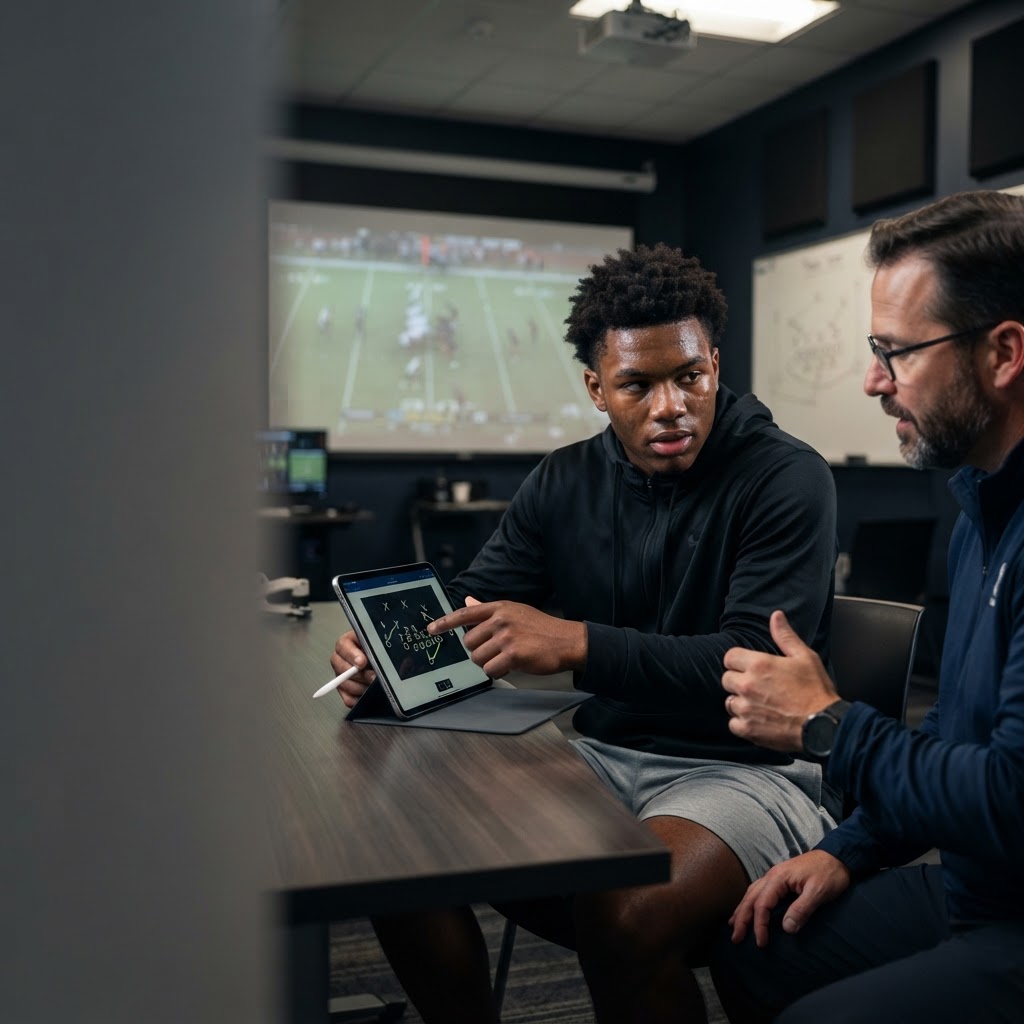
Study your own film weekly. Review each game tape with a specific focus: how many reps did you get to proper pad level? How many reps did you sustain the block through the whistle? Honest self-evaluation accelerates improvement.
Study college OL play. Watching how offensive linemen move at the college level is the fastest way to understand the standard you are training toward. Focus on footwork patterns and hand sequences, not just outcomes.
Understand protection schemes. A recruit who can articulate the difference between man and zone protection concepts, identify pre-snap blitz looks, and communicate adjustments with teammates stands out immediately to coaches.
Communicate what you see. On film and in person, coaches evaluate whether a recruit's eyes work. Proper pre-snap reads, communication at the line, and adjustment execution all show football IQ at the position.
Verified Testing Numbers That Matter at OL {#verified-testing}
Recruiting profiles for offensive linemen should include verifiable athletic testing data. At OL, the relevant metrics are:
- Height and wingspan: Both matter. A long-armed OL can maintain outside hand leverage that shorter linemen cannot.
- Weight: Coaches want functional weight, not just mass. Agility and body composition context matters.
- 40-yard dash: Even at OL, a verified 40 time establishes athleticism. A 5.1 from a 300-pound athlete is noteworthy. Numbers without verification carry little weight with college staffs.
- Broad jump: Lower-body explosiveness and first-step power in one measure.
- Short shuttle / Pro agility: Lateral movement and change-of-direction ability. This number matters more for offensive linemen than many recruits realize.
Testing results that are measured and recorded at a legitimate event carry more credibility with coaches than self-reported numbers. Programs conducting verified testing create a trackable record that travels with an athlete's profile throughout the recruiting process.
Building a Recruiting Profile as an Offensive Lineman {#recruiting-profile}
An offensive lineman's recruiting profile should tell coaches: here is who I am, how I move, what I look like on tape, and where I am academically.
Film quality matters as much as play quality. If your high school film does not show your individual technique clearly, a highlights package or individual drill footage from camps and combines fills that gap. OL who appear only as blockers in the background of skill-player highlights miss the chance to showcase their own development.
Update your profile every season and after major events. A profile from freshman year does nothing for a junior-year recruitment. Coaches want to see current size, current testing numbers, and current film.
Identify the right level. Not every OL recruit is a Power Four prospect, and that is entirely fine. Division II, Division III, NAIA, and junior college programs produce lifelong opportunities in the game. Targeting programs where your size, athleticism, and academics fit the roster profile is smarter than sending one email to Ohio State and waiting.
Communicate professionally. When contacting college coaches, introduce yourself specifically. Name your position, graduation year, GPA, verified 40 time and relevant testing, and link directly to film. Generic emails without data do not move coaches to act.
Offensive Line Development Checklist {#checklist}
Use this as a year-round development reference:
- [ ] Train footwork and pad level every practice session, not only in position groups
- [ ] Film your drill work and individual technique at least once per month
- [ ] Complete a verified athletic testing event and add results to your recruiting profile
- [ ] Review your own game film weekly with a specific technical focus
- [ ] Build a position-specific strength program with lower-body and core emphasis
- [ ] Develop daily mobility work to protect hip and knee health
- [ ] Maintain a GPA that qualifies you for the level you are targeting
- [ ] Contact five to ten programs per month that fit your measurables and academic profile
- [ ] Study college OL technique on film at least once per week
- [ ] Update your recruiting profile with current height, weight, testing numbers, and film each semester
Free Recruiting Readiness Snapshot {#cta}
Be Like Wat3r Exposure LLC offers a free Recruiting Readiness Snapshot at belikewaterexposure.net. The Snapshot evaluates how organized and complete your current recruiting profile is, so you know exactly where to focus before you reach out to coaches.
No recruiting outcome is guaranteed. The Snapshot measures your preparation, not a program's decision.
Visit belikewaterexposure.net to get started.
Education Disclaimer {#disclaimer}
This article is for educational purposes only. Be Like Wat3r Exposure LLC does not guarantee scholarship offers, roster spots, or any specific recruiting outcome. College football recruiting involves decisions made by coaches, athletic departments, and admissions offices outside of any athlete's or third party's control. All information here is intended to help athletes and families understand the process and prepare accordingly.
Know exactly where your recruiting profile stands.
Get Your Free Recruiting Readiness Snapshot