The Recruiting Rulebook Is Changing: What Michigan’s 2027 & 2028 Football Prospects Need to Know Now
BLWE Monday Recruiting + NIL Intelligence Report
September 7, 2026 | Michigan + Midwest | 2027 & 2028 Football
New NCAA eligibility rules, evolving football recruiting calendars, 105-player roster economics and Michigan’s expanded NIL framework are changing how families should plan the next two recruiting cycles.
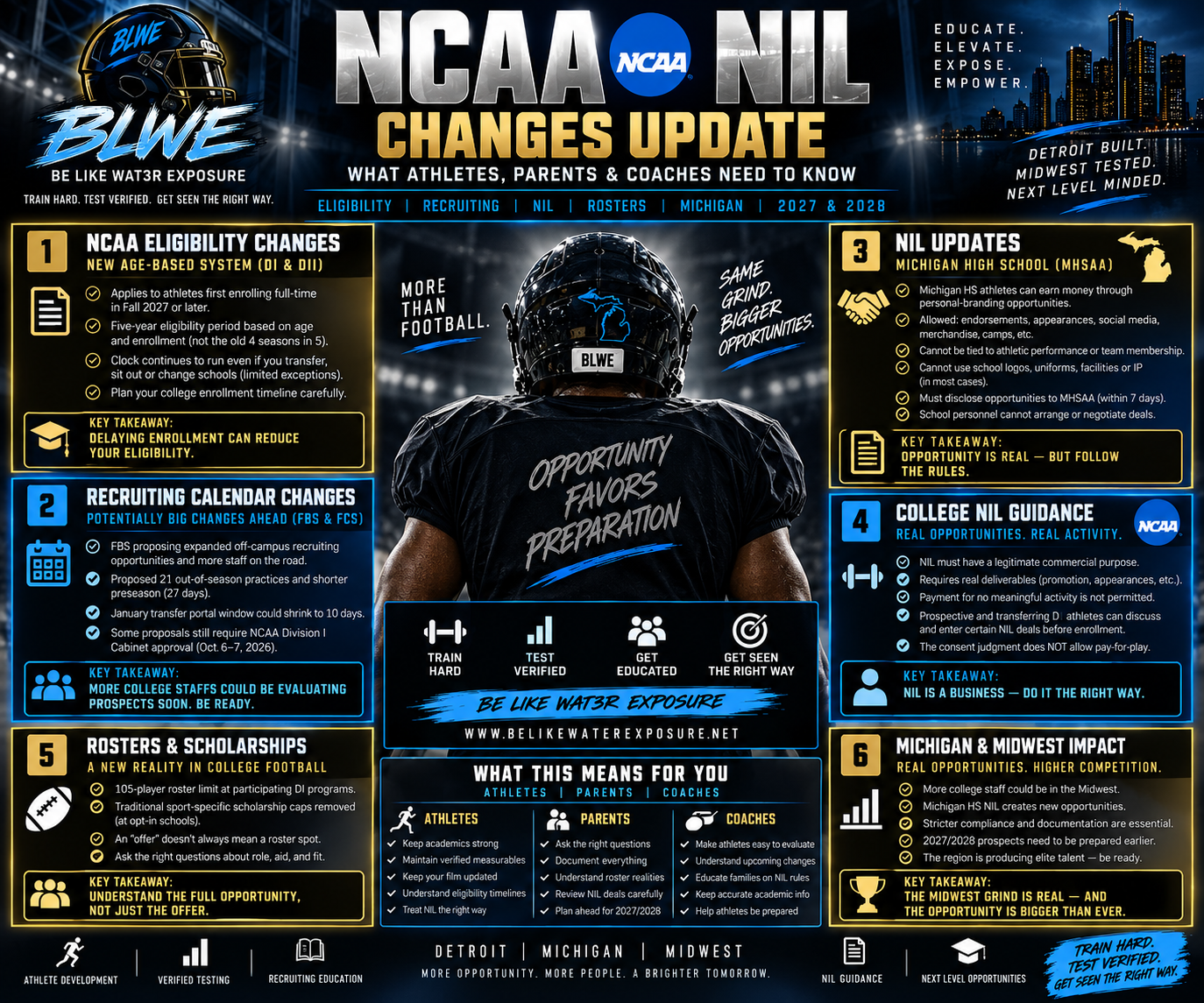
Owner-provided Be Like Wat3r Exposure NCAA and NIL changes infographic. See the source-linked report below for details and proposal status.
Executive summary
Three developments deserve immediate attention. Division I and Division II have adopted an age-based eligibility framework, with transition treatment in 2026–27 and the new model alone for initial full-time enrollment in fall 2027 or later. Major FBS/FCS practice and recruiting proposals still await Division I Cabinet approval. Michigan high-school personal-branding opportunities are permitted, but remain subject to restrictions distinct from college NIL.
For 2027/2028 families, academic planning, verified evaluation, appropriate recruiting communication and NIL documentation should be coordinated—not treated as separate last-minute tasks. A graduation year alone does not establish which eligibility rules apply; initial enrollment and the individual’s circumstances matter.
The winning recruiting strategy is no longer simply “get exposure.” Get evaluated accurately, understand the rules, document the opportunity and make informed decisions.
Four immediate education pieces
- 2027 NCAA Eligibility Has Changed — What Michigan Football Families Need to Know
- Michigan HS NIL: Allowed vs. Not Allowed
- Offer vs. Opportunity: Understanding the 105-Man College Football Roster
- The 2027 Recruiting Calendar Could Change — Why Verified Evaluation Matters More
2027 NCAA Eligibility Has Changed: What Michigan Football Families Need to Know
CONFIRMED — adopted rules, not a proposal. Division I’s adoption announcement was published June 23, 2026; Division II’s was published August 5. The NCAA’s current joint guidance confirms the transition rules below. This replaces Division I’s traditional four-seasons-in-five framework and Division II’s four-seasons/10-semesters-or-15-quarters framework; those previous systems were not identical.
The five-year period begins with the earlier of initial full-time college enrollment and attendance or the applicable age-based academic-year trigger. The NCAA specifies a September 1 birthday distinction: when an athlete turns 19 before September 1, the age trigger is the start of the regular academic year immediately following that birthday; when the birthday is on or after September 1, it is the start of the subsequent academic year unless full-time enrollment occurs earlier. College-team competition can also start the period even without full-time enrollment. High-school/college dual enrollment does not itself start it.
Once started, the period generally runs continuously through transfers, sitting out, team changes or time away. Under the new model, seasons-of-competition counting, athletics redshirts, delayed-enrollment/organized-competition rules and several waiver categories are removed. Limited exceptions include pregnancy, active-duty military service and official religious missions, subject to the NCAA’s conditions and documentation. Families should obtain an individual review rather than assume an exception applies.
Transition matters:
- Initial full-time enrollment in fall 2027 or later: age-based rules only.
- Initial full-time enrollment during 2026–27: the previous or new rules, whichever is more beneficial.
- Current athletes with eligibility remaining after 2025–26: transition review under the more beneficial model.
- Athletes who exhausted eligibility under the previous rules in 2025–26 do not automatically receive another season.
Five years are not guaranteed. Academic and other eligibility requirements still apply. A gap year, prep-school plan or delayed college start can reduce the available period; transferring does not reset it.
Family planning worksheet — keep private: Date of birth → expected high-school graduation → expected first full-time college enrollment/attendance → any prior college competition → DI/DII compliance-review flag. This is a private planning record, not an automated eligibility decision. Keep exact birth dates and academic records out of public recruiting posts; use an authorized private channel with a guardian involved where appropriate.
Action: Before delaying enrollment, ask the NCAA Eligibility Center and the prospective college’s compliance office to review the actual timeline. Register with the Eligibility Center when appropriate and continue academic planning.
Sources: NCAA joint age-based guidance, Division I adoption, Division II adoption.
Michigan HS NIL: Allowed vs. Not Allowed
CONFIRMED — Michigan high-school PBA, not unrestricted college NIL. MHSAA’s January 27, 2026 announcement expanded individual personal-branding activities effective immediately. Opportunities must comply with MHSAA rules and the athlete’s school policy.
Potentially allowed when compliant: individual endorsements and social promotions, personal appearances, photo/autograph sessions, modeling, advertising, merchandise, apparel or sports-card sales, and use of an individual’s name, image or likeness in marketing.
Not allowed under the announced policy:
- Compensation based on athletic performances, awards/recognition, team participation or competition outcomes.
- Use of school names, logos, mascots, trademarks, uniforms or other obvious school identifiers/intellectual property.
- PBA during school attendance or MHSAA events, including practice; activity on school property or promotion through school media channels.
- School employees—including coaches—soliciting, arranging, negotiating or promoting deals for their athletes.
- Collectives or booster/school involvement inconsistent with the individual-opportunity restrictions.
- Inappropriate or unsafe industries, including the announcement’s examples of gaming/gambling, alcoholic beverages and banned substances.
Disclosure and approval: MHSAA requires disclosure within seven days of an opportunity or contract for disclosure and approval. Do not treat disclosure as automatic approval. Schools may adopt stricter policies. Review the current MHSAA policy and school requirements before signing, posting or performing deliverables; involve a parent/guardian and qualified adviser when appropriate.
BLWE pre-deal checklist: Check the athlete’s applicable rules → company and industry → deliverables and payment → school/IP usage → booster or school connections → timing and location → disclosure/approval requirements → retained contracts and records. Another athlete’s post is not proof that your deal is permissible.
College NIL still requires real commercial activity
The NCAA’s current NIL guidance describes genuine third-party NIL as compensation for actual promotion, appearances, endorsements or similar activity with a valid business purpose and reasonable compensation. Payments with no meaningful deliverables, undefined future use or pay-for-play remain problematic. This discussion concerns third-party commercial NIL, not every category of institutional benefit under the House settlement.
The NCAA’s April 1, 2025 consent-judgment explanation permits prospective and transferring athletes to discuss, negotiate and enter commercial third-party NIL contracts before Division I enrollment, and permits institutions to assist with potential commercial opportunities. It does not authorize prohibited athletic-performance payments or payment for work that will never occur. This does not override Michigan high-school restrictions.
Keep records for applicable college reporting as well. Current NCAA guidance tells high-school prospects planning Division I participation to report qualifying third-party deals of $600 or more, aggregating smaller payments from the same payer, within 14 days after starting full-time classes or before the first Division I game, whichever is earlier. The lookback begins July 1, 2025 or the start of junior year, whichever is later. Confirm individual requirements with the college’s compliance office; MHSAA’s seven-day process is separate.
Sources: MHSAA announcement, MHSAA current NIL/PBA policy, NCAA NIL guidance, NCAA consent-judgment explanation.
Offer vs. Opportunity: Understanding the 105-Man College Football Roster
CONFIRMED — participating Division I institutions, with exceptions. House-settlement implementation introduced a 105-player football roster limit at participating institutions, replacing the former sport-specific scholarship caps with a roster-based framework permitting aid to any or all rostered athletes. Permission to award aid is not a promise of 105 fully funded scholarships, playing time or a place for a particular recruit.
Designated student-athlete exceptions matter: certain protected athletes do not count against the roster limit for the duration of their eligibility. A published roster larger than 105 is not, by itself, proof of a rules violation. Do not apply the participating-institution model indiscriminately to every college football program.
The NCAA also states that core scholarship protections remain: athletics aid cannot be revoked solely because an athlete loses a roster spot for roster management, athletics performance or injury unless and until the athlete chooses to transfer. Ask the institution to explain the applicable written terms and protections.
Questions before treating an offer as a durable opportunity:
- Where do I sit on the program’s actual recruiting board?
- Is the opportunity documented in writing, and what conditions apply?
- What is the financial-aid amount, duration and structure?
- What admissions and eligibility requirements remain?
- What happens to my aid and participation if roster plans change?
- What position does the staff project, and who is my recruiting contact?
Save the dated communication and ask the institution for clarification. A social-media graphic is not a substitute for written terms, admissions clearance or an official roster decision. BLWE does not certify private scholarship promises or guarantee offers.
Sources: NCAA roster adoption and scholarship protections, House implementation FAQ — roster limits and designated athletes.
The 2027 Recruiting Calendar Could Change: Why Verified Evaluation Matters More
PENDING — specified provisions require Division I Cabinet approval. NCAA’s August 28, 2026 report states that FBS Oversight adopted proposals, but Cabinet approval at the October 6–7 meeting is required for the specified changes to take effect January 1, 2027. Oversight approval is not final Cabinet adoption.
The proposed FBS model includes:
- Two out-of-season practice periods totaling 21 on-field practices, over no more than seven combined weeks; neither period may exceed five weeks.
- At least nine discretionary/voluntary weeks without required athletically related activities.
- A 2027 preseason of 27 calendar days and 21 practices.
- A January transfer-notification period shortened from 15 to 10 days, starting the first business day after January 1.
Separately CONFIRMED: NCAA describes the 2027 FBS first-contest timing as already adopted: the season starts on the Thursday of what is now Week 0 and ends the Saturday after Thanksgiving. That statement concerns the regular-season calendar, not the end of postseason competition.
Expanded off-campus recruiting staff: pending
The July 23 FBS recommendation would permit up to 300 off-campus recruiting person-days during winter/spring periods, up to 50 fall off-campus evaluation days, and up to 16 program staff members plus the head coach—17 total—recruiting off campus. A person-day allocation is a program staffing measure, not a promise that a recruit receives 300 days of contact. The recommendation targets January 1, 2027 and awaits Cabinet consideration.
NCAA’s September 1 FCS report describes a similar proposed practice/calendar package and up to 17 off-campus recruiters. It would also change the fall evaluation period into a contact period. Those provisions remain subject to Cabinet approval. Do not assume every FBS numeric allocation also applies to FCS.
BLWE analysis, not a guaranteed outcome: If adopted, programs could allocate more recruiting staff to evaluation and outreach. Athletes still need to be easy to evaluate; additional staffing does not guarantee interest, visits or offers. Continue following the currently applicable recruiting calendar until official changes take effect.
Prepare a concise, current recruiting package: verified measurables with testing date/method → current game film → position and graduation year → accurate height/weight → school-coach contact shared with permission → recruiting profile. Share transcripts and other private academic information only through appropriate authorized channels, not public profiles or social posts. Update film during the season instead of waiting until December.
Sources: FBS calendar package and adopted first-contest timing, FBS off-campus recommendation, FCS package, NCAA recruiting calendars.
BLWE action board
Athletes: Keep film and verified measurables current, maintain academics, complete appropriate Eligibility Center steps, review enrollment timing before a gap/prep year, and treat NIL as documented business activity rather than recruiting currency.
Parents and guardians: Document communications and offers; ask about roster standing, aid, admissions and eligibility. Do not equate social attention with scholarship security. Review contracts, school policies and MHSAA requirements before NIL posting or performance.
Coaches: Keep recruiting information accurate, share private academics only with authorization, and monitor the pending 2027 changes. School personnel must not arrange Michigan high-school NIL activity where prohibited.
BLWE education priorities: Use the four focused pieces above in recruiting-readiness conversations. Refer individual eligibility questions to the Eligibility Center/college compliance office and NIL contract questions to qualified advisers. Use the private Enrollment & Eligibility Timeline in the administrator eligibility tracker to record birth date, graduation year, expected or actual first full-time enrollment, compliance-review status and notes. Review flags are entered by an administrator; they are not automatic NCAA eligibility rulings.
Fact-check desk
CONFIRMED as of September 7, 2026: DI/DII adoption and transition treatment; age-based rules alone for fall-2027-or-later initial full-time enrollees; participating-institution football roster limits with designated-athlete exceptions; Michigan’s PBA expansion and restrictions; the adopted 2027 FBS first-contest timing.
PENDING as of September 7, 2026: Specified FBS/FCS calendar, practice, transfer-notification and expanded off-campus recruiting provisions requiring Cabinet action. Recheck after October 6–7; no future approval is assumed.
NOT REPORTED AS FACT: Private recruit NIL valuations, collective promises, undocumented scholarship terms, rumored roster guarantees or speculative recruiting interest.
This is an as-of-date educational report, not legal advice, an individual eligibility certification, or NCAA/MHSAA endorsement. Rules and implementation guidance can change; consult the primary sources before acting.
Your next step
Train Hard. Test Verified. Get Seen the Right Way. — Be Like Wat3r Exposure
Review recruiting readiness · Explore camps and combines · Request an evaluation · Visit the NIL resource hub
Know exactly where your recruiting profile stands.
Get Your Free Recruiting Readiness Snapshot